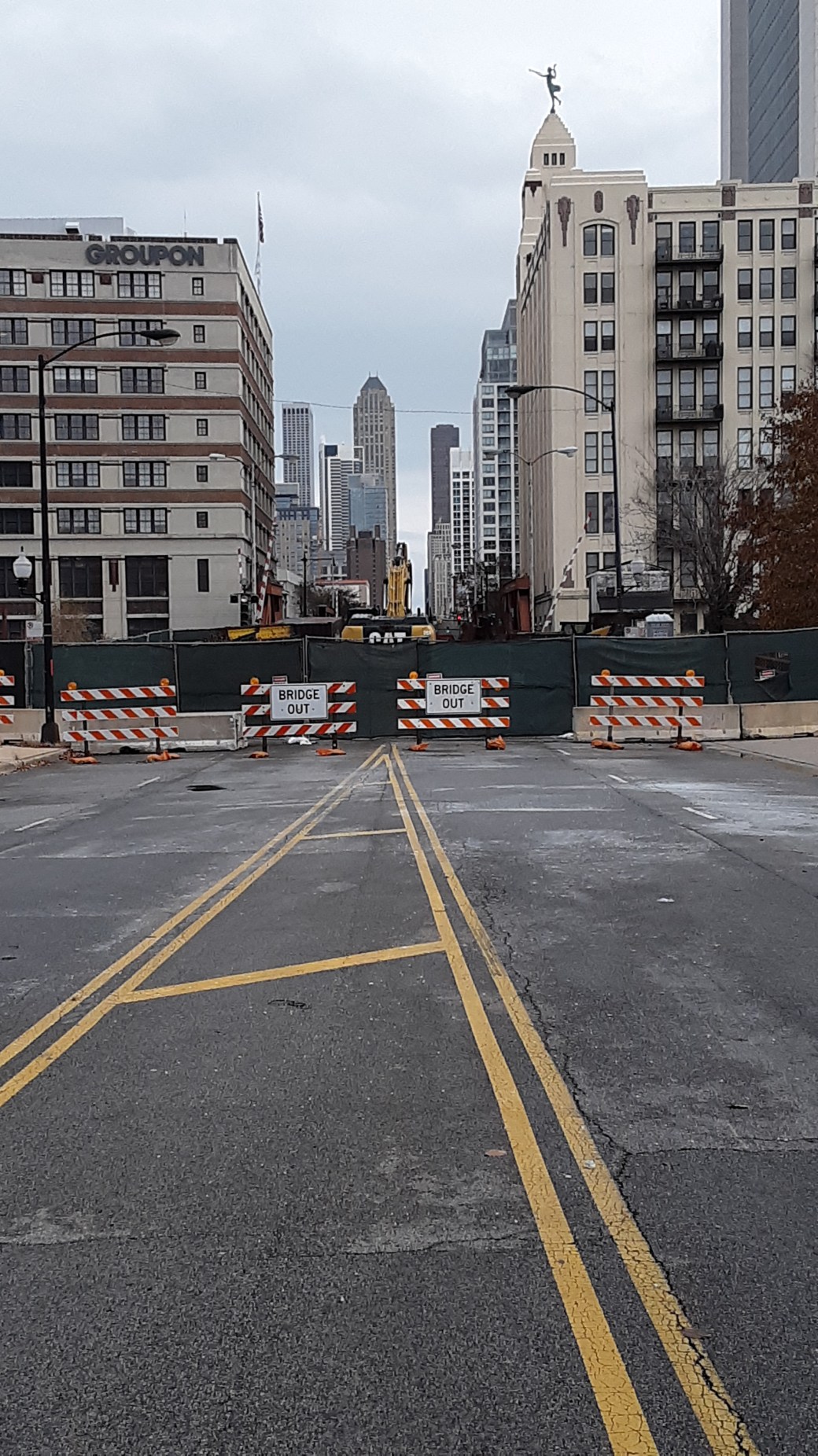
Farwell Avenue Red Line Viaduct

Farwell Avenue Red Line Viaduct


Farwell Avenue Red Line Viaduct

Farwell Avenue Red Line Viaduct

Farwell Avenue Red Line Viaduct


Farwell Avenue Red Line Viaduct
The Morse Theater was located at 1328 Morse Rogers Park. It began operations in 1912. It operated as a vaudeville venue and a nickelodeon movie theater. It had a capacity of 600 seats.
In the 1930’s, the theater was remodeled in the art deco style. It was renamed the Co-Ed Theater (a reference to the nearby Loyola University). It operated from 1930 to 1954.

Photo from early 1900’s Internet Photo

Mayne Stage

Mayne Stage Theater

Mayne Stage Theater

Mayne Stage Theater

Mayne Stage Theater
From 1956 to 1977, it became home to a synogogue for the Congregation Beth Israel Anshe Yanova. The congregation later relocated to a location in Skokie at 3601 Dempster Street.
In 1977, the building was acquired by the Geroulis family. It housed their business Cobblers Mall until 2004. It moved to a nearby smaller location.
In 2008, the building underwent an extensive 6 million dollar renovation to become a high end jazz club. It opened in October of that year. Its name was changed to the Morse. In August of the same year, the building was damaged by a fire. It was suspected that it was a case of arson. In 2009, following an unresolved dispute between the building owners and the operators, the Main closed.
Probably one of the most elaborate and one of the largest movie theaters on the north side of Chicago was the Granada Theater. It was built in the Spanish Baroque Style. It was located at 6427 N. Sheridan Road in Rogers Park. It was built for the Marks Brother Circuit. The architect was Edward Eichenbaum.
The Granada opened in 1926. It was designed for live stage shows and movies. It had one screen. Its capacity was 3,448 seats.
The theater was sold to Balaban and Katz chain in 1932. After a brief closure, it reopened in 1933. It began showing double feature films. By the 1940’s, the Granada was only showing movies. During the ensuing years, the theater was managed by United Paramount, ABC Great States and Plitt Theaters. It closed in 1978.
From 1978 until the mid 1980’s, it was occasionally used for rock concerts.
The theater was purchased by Senior Life Styles Corporation . They demolished the building in 1989–1990. A joint venture of SLC (senior life styles corporation) and Loyola Development Company was responsible for construction of a 16 story mixed use complex to be called the Granada Center. The project began in March, 1990 and completed by spring, 1991.
The plan was for 166 rental apartments and a parking garage. There was to be 75,000 square feet of rental retail and office space.
Loyola University was to occupy 31,000 square feet of office space on the second, third, and fourth floors. The ground floor and the balance of the second floor was to be occupied by retail shops, convenience and service businesses.
The architect for the project was the firm of Mann, Gin, Ebel & Frazier, Limited. Project cost was $24.5 million. Financing was through American National Bank and Trust Company of Chicago.

Granada Theater Rogers Park Internet Photo

Lobby Granada Theater Internet Photo

Granada Theater Shortly Before Demolition Internet Photo
The building was subsequently purchased by Loyola University. This was used for student apartments, retail space and university offices.

Granada Center at the former site of the Granada Theater.

Granada Center

Granada Center

Granada Center
The New 400 Theater is located at 6746 North Sheridan Road in Rogers Park. This is the most recent of many names given to this location

400 Theater

Front of 400 Theater
The first name of this venue was the Regent Theater. It opened in late 1913 as a vaudeville and movie house. It had one screen and a capacity of 725 seats.
In 1930, it was renamed the 400 theater. This was a reference to a popular term describing the top 400 individual in high society.
In 1990, the venue was divided into four separate auditoriums–3 with seating of 200; one with seating of 150.
It was purchased by the owners of the Village Theater in Old Town. It was modernized and renamed the Village North Theater.
In September, 2008, it began operating as a Visionary Theater.
In January, 2009, it closed.
It reopened in July, 2009 as the New 400 Theater

Current Photo 400 Theater

Current Photo New 400 Theater

400 Theater Current Photo

400 Theater Current Photo

400 Theater Current Photo

Old internet photo 400 Theater

400 Theater

400 Theater

400 Theater

400 Theater

400 Theater

400 Theater

Inside Hall 400 Theater
Unless otherwise indicated, all photos and text are copyrighted
Located at 1749 West Howard in Rogers Park was the Norshore Theater. It opened on June 17, 1926. The architects were Cornelius Ward Rapp and George Leslie Rapp. The theater was a large structure with 3017 seats and one screen.
It was quite an elaborate structure. It was built in The French Renaissance Style. The lobby had crystal chandeliers. The ceiling was elaborately decorated with Pompeian motiffs. There were fine antiques and and a Wurlitzer pipe organ.
Originally, the Norshore was managed by Lubliner and Trinz Circuit. Later Balaban and Katz assumed the management.
The theater closed in 1957. It was demolished in 1960. At the former site, there is the Gateway Center Shopping Plaza.

Gateway Center Shopping Plaza

Gateway Center Shopping Plaza

Gateway Center Shopping Plaza

Norshore Theater Internet Photo

Norshore Theater Management was Balaban and Katz

Lobby of Norshore Theater. Internet Photo
This theater was located at 6225 N. Broadway in the Edgewater neighborhood. When it first opened in 1915, it was called the Knickerbocker. It had one screen and 949 seats. It was part of the Lubliner and Trinz Circuit.
The name was changed to the Devon Theater in 1929. The management of the theater was taken over by Essaness at the same time. It operated as a second run house. It had a plain appearance compared to the neighboring Granada.
The theater operated until the 1970’s. For a while a church operated in the building. The theater was razed in 1996 by Loyola University.

Devon Theater Internet Photo

Devon Theater Internet Photo

Devon Theater Internet Photo

Likely Site of the Devon Theater
From 1912 to 1916, there was a small Nickelodeon theater in Rogers Park at 6916 N. Clark Street. It was called the Park Theater. It had one screen. Its capacity was 300 seats. It was owned by Tagney and Hudson and Edward Benson.
The site is currently occupied by a muffler and auto store

Site of former Park Theater

Former Site of Park Theater

Internet Photo Casino Theater
For a brief period of time, there was a movie theater at 7051 N. Clark in Rogers Park. It was named the Casino Theater. It had only one screen. Its capacity was 299 seats. It apparently operated only from 2013 to 2014. The former site of the Casino Theater is unrecognizable. An arched parapet at this site was removed a long time ago.

Former Site of the Casino Theater

Former Site f the Casino Theater

Site of Howard Theater Rogers Park

Site of Howard Theater Rogers Park

Site of Howard Theater Rogers Park

Site of Howard Theater Rogers Park

Site of Howard Theater Rogers Park

Sites Howard Theater Rogers Park

Site of Howard Theater Rogers Park
One of Rogers Park former treasures was the Adelphi Theater. It was located at 7074 N. Clark Street (Clark and Estes). It was designed by John E.O.Pridemore. It opened on November 10, 2017. It was managed by Archer Brothers Circuit. It had one screen and had 999 seats.
In the 1930’s, it was remodeled in the Art Deco Style. It was remodeled in the 1940’s and in the 1950’s.
Starting in the 1960’s, it began to show second run features. It closed briefly in the early 1980’s. In the mid 1980’s, it reopened as the North Shore Cinema. It closed briefly again and reopened as the Adelphi. At this time, it showed East Indian films and Bollywood features. Unfortunately, over the years the theater deteriorated. It closed in January, 2002. Despite efforts to save the structure, it was demolished in 2006 to make way for a condo project which was never completed. It is now an empty lot.

Adelphi Theater Internet Photo

Adelphi Theater Internet Photo

Adelphi Theater Newspaper Photo

Adelphi Theater Internet Photo

Prior Site of the Adelphi Theater

Former Site of Adelphi Theater