Lock 1 Lockport, Illinois

In the history of the Illinois Michigan Canal, there were actually two structures known as Lock 1.   There was the Lock 1 located in Lockport.  This was one of the 15 original locks designed by William Gooding, the chief engineer.  The second Lock 1 was located at the junction of the canal and the Chicago River.  This was designed and proposed after the canal ran into financial trouble.  It was needed when the deep cut was abandoned for the shallow cut.

We are discussing the Lockport facility in this blog.  It was one of the first locks constructed ( 1838).  The contractor was George Barnet.  The I and M Canal was 120 feet wide before Lock 1 and 100 feet after.   There was a 40 foot drop between Lockport and Joliet.   This feature made this area attractive for the development of hydraulic power.

Both Lock 1 and Lock 2 were originally

wpid-wp-1439334517836.jpeg

Lock 1 Lockport, Illinois

designed to provide lift and hydraulic  power.  Lock 1 had many features in common with the other original structures.  It was 110 feet in length.  It was 18 feet wide.  Its height was 20 feet.  It foundation was on bedrock.  It was covered by wooden flooring.  Its walls were made with locally mined limestone.  The gates were timber.  The lock lift was 10 feet the same a lock 2.

Many of the features were unique because of the hydraulic function of the lock.  The upper and lower wing walls were longer and more elaborate.  There was a bypass channel to the east of the lock. Water was channeled from an opening down a power sluice back into the canal.    This hydraulic function was not operational until the flow in the Chicago River was reversed down the Illinois Michigan Canal in 1871.  The John Marx Tannery used the hydraulic power and operated until the end of the century.

In the 1980’s, the deteriorating lock structure was reinforced.  A concrete floor and retaining walls were constructed.    There are no gates in the lock.  Water still flows through the lock.


wpid-wp-1439334277502.jpeg

Lock 1 

wpid-wp-1439423686125.jpeg

Lock 1 Lockport, Illinois


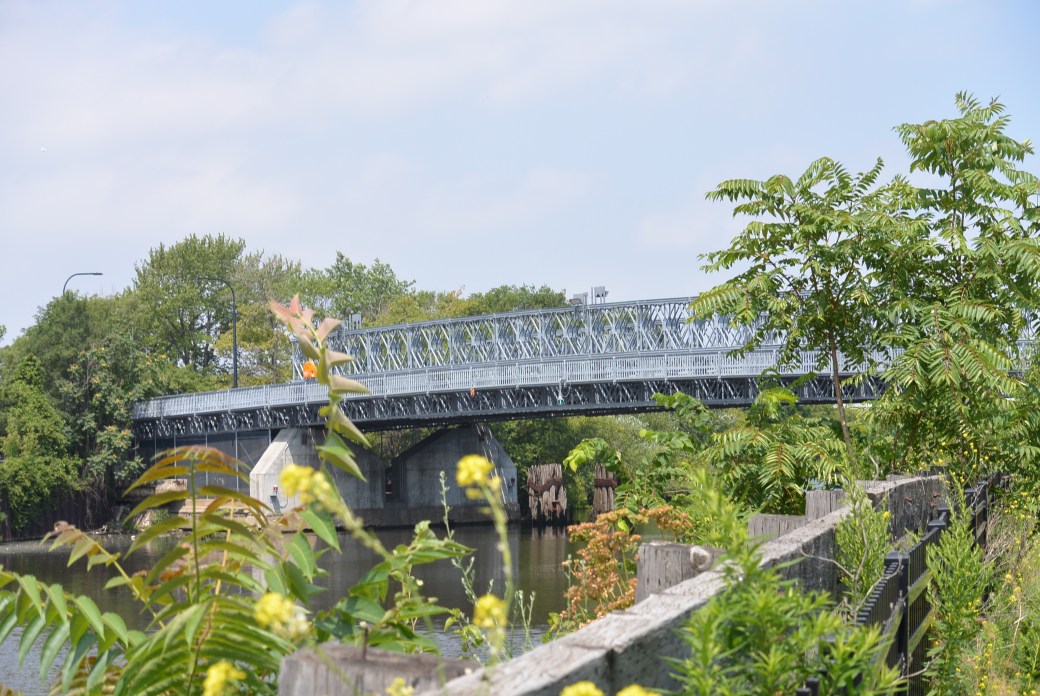
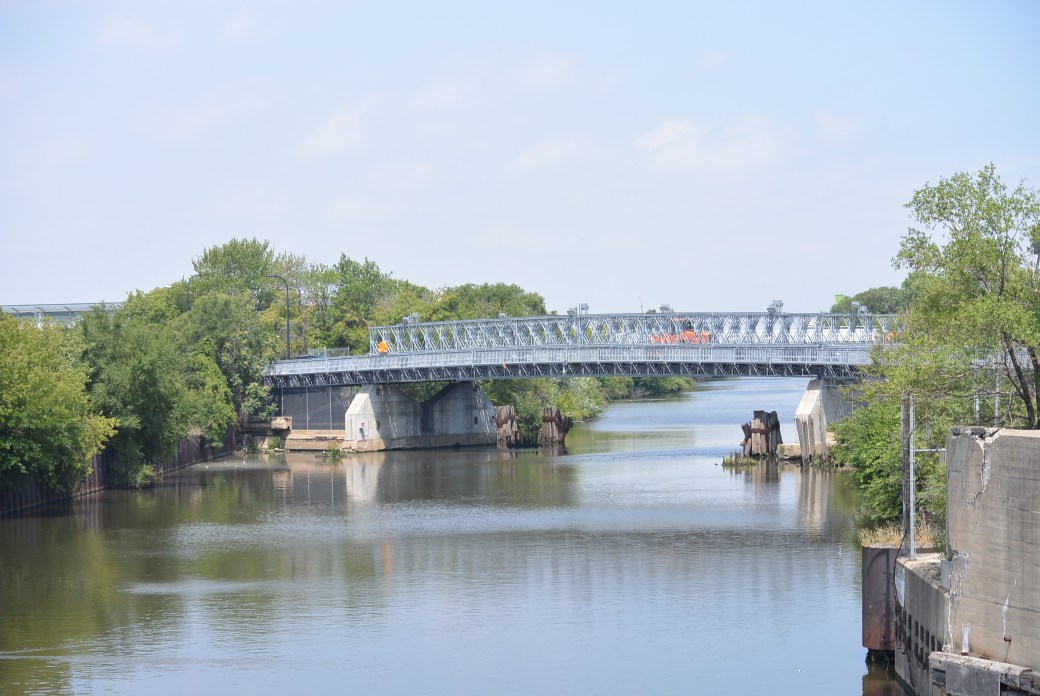
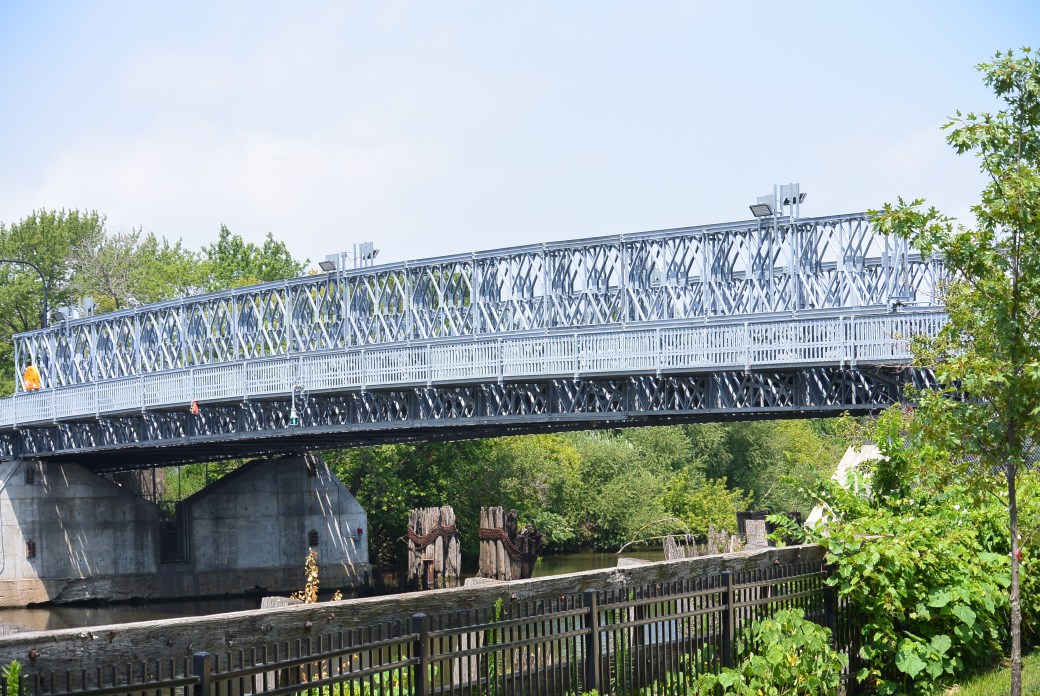
Ottawa Railroad Bridge

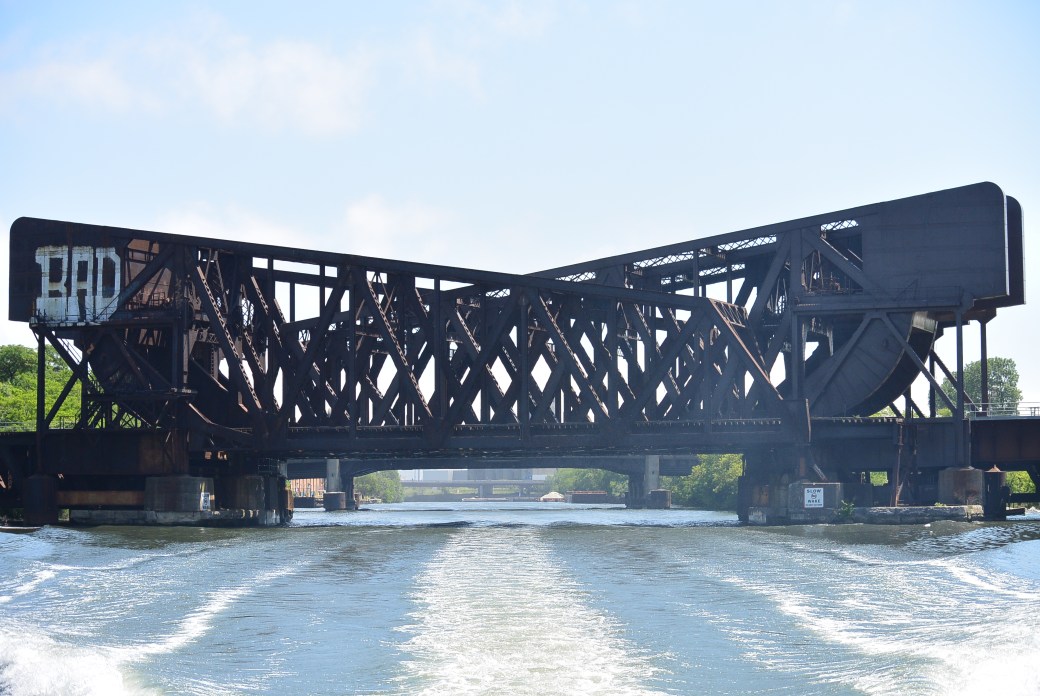
This bridge crosses the Illinois River west of the confluence of the Fox and Illinois Rivers.  The original bridge was built in 1871.  It was leased by the Burlington from the Ottawa, Oswego, and the Fox River Valley Company.

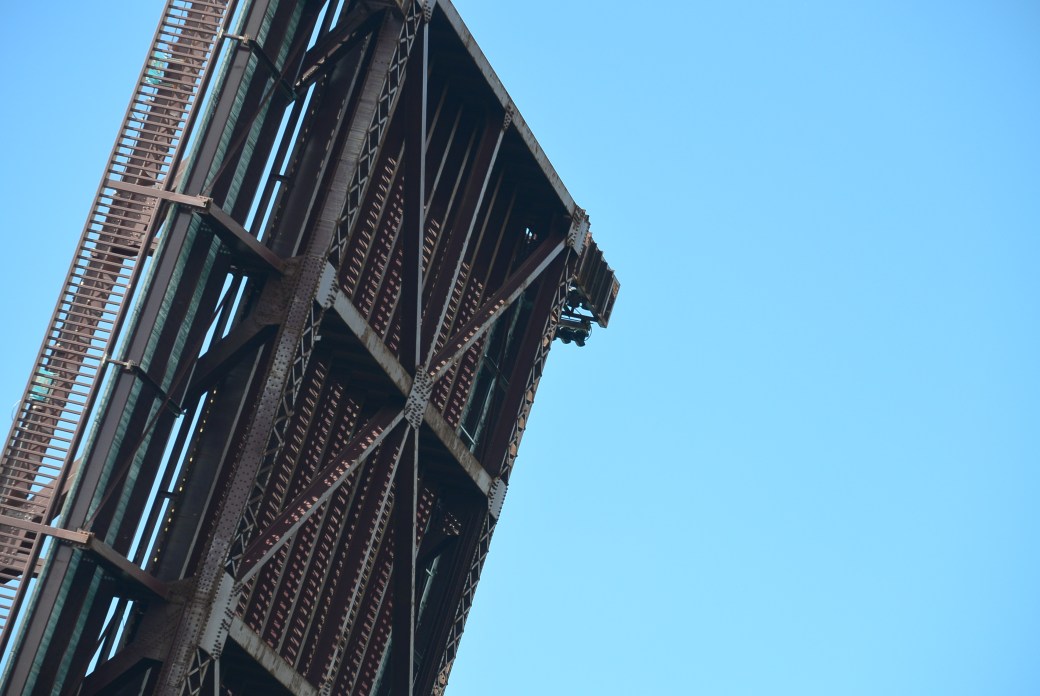
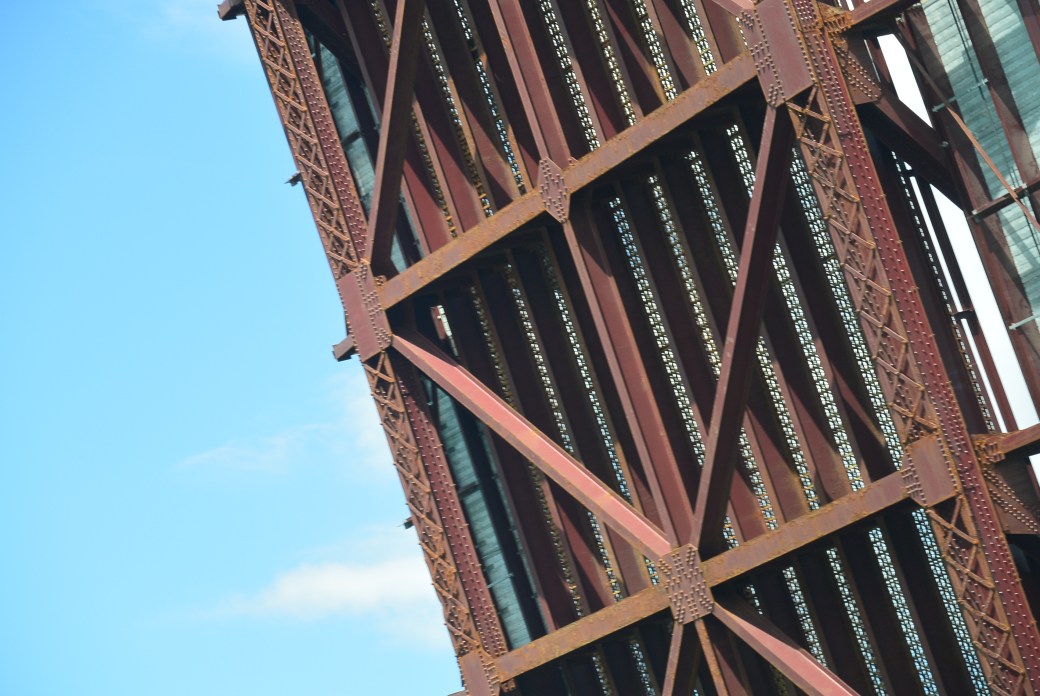
The current bridge was constructed for the Burlington in 1898  by the King Bridge Company.  Its total length is 800 feet.  Its height is 21 feet above the water.  Originally the bridge was a steel multispan fixed bridge.  In 1932, the center span was reconstructed and retrofitted with  a Waddell and Harrington Engineers Vertical Lift.  There are timber trestle approach spans to the north and south.  There are limestone piers. There is only a single track in the bridge.

When the Burlington became the Burlington Northern, this bridge was sold off. As of 2009, the last known owners were Illinois Railway Net.

In 1997, trains ran across the bridge twice a week.  South bound at 11 am; North bound at 3 pm.  This was on Tuesdays and Thursdays.  Cargo was sand from U.S Silica and Wedron Silica to the Norfolk Southern in Streator.    Also carried was lumbar to a yard in Streator.

image

image

image

Fox River Feeder Canal

For a period of time in the history of the Illinois Michigan Canal, there was a feeder canal present originating near Dayton, Illinois and proceeding south and west to intersect the main canal in Ottawa.

The feeder originated from the Fox River just above a dam.  It was 4.7 miles in length.  It was 40 feet wide at the surface; 26 feet at the bottom.   Its depth was 4 feet. It had its own towpath.  It was navigable by small vessels.  There were mills and grain elevators along its course.  The feeder had a troubled history.  In 1871, when the course of the Chicago River was reversed, it was allowed to dry up.    During the depression, its bed was mined for coal.

Contractors associated with this feeder canal include:  Howe, Hall, Lord, Green, Stratton, Donovan, Nadder and Walker.

image

Site of a towpath bridge across the later canal. Looking north along the course of the Fox River Feeder

image

Dayton Dam Fox River. Note this is not the original dam at the time of the Fox River Feeder

Lock 10 Illinois Michigan Canal

This lock was one of the original designed by the William Gooding, the chief engineer of the I and M canal.  It was constructed in 1845-1848.    Its length was 110 feet.  Its width was 18 feet.  Its walls were originally sandstone.  It had timber gates.  Its lift was 8.3 feet.  It a few hundred feet west of Lock 9.

In 1865, its walls were partially rebuilt in timber.  In 1877-78, its wall were reconstructed with ashlar limestone. The lock was in operation until the 1930’s.

The CCC rebuilt the walls with concrete a few years later.  There are no longer wooden gates.  There is currently no water in the lock.

image

Lock 10

image

Lock 10. I and M Canal

Lock 8 Illinois Michigan Canal.

There are many interesting canal structures in the area where the Aux Sable Creek intersects the canal.  There is an aqueduct, a lock keeper house and Lock 8.

Lock 8 is one of the original 15 locks designed by the chief engineer William Gooding.   It was built in 1848.  As constructed, it was 18 feet in width and 110 feet in length. It has a lift of 6.5 feet.  The lock wall was made with ashar limestone.   In years gone by, some of the limestone blocks were replaced with concrete.  The gates were made of timber.    Total original construction cost was $ 4,500.00

In 1887, a sawmill and a barrel factory were located just north of the lock. These facility were powered with water traveling down a spillway.    There is no evidence currently of these two plants.

In 1936-7, the CCC renovated the lock.  The lock walls were repaired.  The timber gates were replaced with like material.

The upstream lock gate was replaced sometime between 1959-1964 with a non movable concrete gate.  Later the downstream gate was completely removed.

Contractors was Mattison and Company.

image

Lock 8 and toll house

image

Lock 8

Lock 15 Illinois Michigan Canal

In planning and building the Illinois Michigan Canal, it was only logical that William Gooding (Chief Engineer of the I and M canal) would consult with someone with more experience than him.   He chose Benjamin Wright.   He had been chief engineer for the Erie Canal and the Chesapeake and Ohio Canal.   They developed the plans for the 15 I and M Canal locks in 1837.   These were to be 18 feet in width and 110 feet in length.  Stone for the lock chambers was mined locally.  Natural and hydraulic cement was used to join the stone blocks.  The gates of the locks were made of timber.  Most were constructed during the  period from 1846-1848.  The locks were kept in place until the 1930’s.  The CCC did extensive renovation during the depression years.

Lock 15 was the most western lock.  It had a lift of 11.52 feet.  It was situated between the steamboat basin and the canal boat basin. The lock has been submerged since the 1930’s.  The gates have been removed.

Contractors involved in the construction included : Cooper, Sanger, Grubles.

image

Lock 15

image

Lock 15

Aux Sable Aqueduct Revisited

At the site of the crossing of the I and M canal and Aux Sable Creek, there is an aqueduct.  The original aqueduct was completed in 1847.  Its superstructure was a 2 span timber Howe truss.  This was supported by limestone piers.    It was 136 feet in length and 28 feet wide.   In 1927-8, the wooden aqueduct was replaced by a steel structure.    In 1948, the limestone piers and abutments were reinforced.  After 1986, the piers were rehabbed.  The superstructure was painted.

Currently, the aqueduct is a trough with riveted steel plate girders.  This rests on ashlar limestone piers and abutment.

According to records kept in the Illinois State Archives, the following is a list of contractors working on the aqueduct:  Matteson, Campbell, Hall, Lord, Wall, Sordslo, Kinsley, Mallison.

image

Aux Sable Aqueduct

image

Aux Sable Aqueduct

Westclox Revisited

Charles Stahlberg was an inventor from Waterbury, Connecticut.  He came to LaSalle Peru with  a plan to establish a clock factory.    Nowhere in my research can I find why he chose this area.  He had an idea for improved manufacturing of low cost clocks.  This idea was patented in 1885  (326,602).

     He was able to attract local investors to help  establish his business.  With this financing, he was able to build a small plant ( 3 stories; 100 feet long by 40 feet wide).  On 12/23/1885, the new company called United Clock  Company began operations. It was a small operation.  It had 25 employees.  Production averaged 50 alarm clocks a day. The factory was struggling from the beginning.  In 1887, they filed for bankruptcy.

     This might have been the end of the story if not for F.W. Mattiesen.  He was a local businessman who was part owner of a zinc smelting plant.  He bought the plant and founded the Western Clock Manufacturing Company in 1888.  Mr. Mattiesen provided new management and capital for the company.  Early on there were manufacturing, financial and marketing issues.   Mr. Mattiesen had to put money in the business for years. 
The business grew because of the quality of its product and the fair treatment of its customers and employees.  The plant was expanded.  Modern machinery was was brought into the plant.   By 1890, there were 81 workers; by 1900, there were 245; by 1910, there were 896.  It expanded its market to foreign customers.
The company obtained a patent for the Big Ben Alarm Clock Movement in 1908.  The bell mechanism was integral to the clock case.    This clock was first brought to market in 1909.  In 1910, the Big Ben was the first alarm, clock to be advertised nationally (In the Saturday Evening Post).

The company name was shortened to Western Clock Company in 1912.   It was incorporated in 1919.  In 1931, the company merged with Seth  Thomas Clock Company.  Both companies became divisions of General Time Corporation.  The LaSalle  Company was known as the Westclox Division of General Time Corporation in 1936.

In 1938, Westclox debuted its first portable travel alarm clock.

During the second World War, General Time and subsidiaries produced aviation instrumentation and control components, compasses for the army, and clocks for the navy.  During 1942-1944, Westclox ceased all domestic production and concentrated on resources for the war effort.  They became a major producer of of fuses for military ordinance.

For years starting in 1899, Westclox produced inexpensive pocket watches.  They continued in this effort to the 1990’s.

in 1959, Westclox introduced its drowse alarm.  They also received a patent for this.  In 1972, they introduced a quartz movement.

In 1968, Talley Industries acquired General Time. In 1988, General Time was purchased by its  management from Talley Industries.    Bankruptcy followed.  The Westclox and Big Ben trademarks were sold to Salton, Inc in 2001.  In October 2007, Salton sold its entire product line to NYL Holdings.

The LaSalle Peru factory was closed in 1980.  At its peak, Westclox employed 2800 workers.  Its plants covered over 20 acres.

On January 1, 2012, there was a fire at the Westclox compound in Peru.  The fire destroyed approximately one half of the structures.  The fire was apparently secondary to arson.

Recently, a Westclox Museum has been established in one of the old buildings of the plant.  It address is  320 5th Street, Suite 265, Peru, Illinois.  There is a substantial collection of clocks and other products made by Westclox.    I highly recommend it.


image

image

image

image

image


Nettle Creek Aqueduct Revisited

This aqueduct is located near Morris, Illinois.  It traverses Nettle Creek.  It is 80-90 feet. It was constructed in 1847.  The contractors were William Pierce and a Mr. Armstrong.  The original construction was a wood superstructure and redstone piers.    The wood structure was replaced by a steel trough.  Later modifications were made of the superstructure.  The sandstone piers had to be replaced by cut stone.  The aqueduct was destroyed by a flood in April 19, 2013.   It is still in this condition.  There is no water in the aqueduct and consequently there is no water in the canal just west of the aqueduct.

The project to replace this aqueduct has been on hold due to the lack of state funds.

Fox River Aqueduct Revisited

The Fox River Aqueduct was originally completed in 1848.  It was the largest of the Illinois Michigan Aqueducts measuring 464 feet in length.  The superstructure was originally made of wood later replaced with metal.  This was supported with limestone piers.  This structure crossed  was the Fox River in Ottawa

.  Main contractor was David Sanger and Sons.  Other contractors mentioned in canal records included:  William Howe and a Mr. Williams.  In addition to carrying the water of the I and M canal; the structure at one time carried the trains of an electric line.  The aqueduct is currently dry.