Old Chain of Rock Bridge

Old Chain of Rocks Bridge

Old Chain of Rocks Bridge

     The Old Chain of Rocks Bridge crosses the Mississippi River on old US 66.  It is south of the I 270 Bridge.

    The bridge was built as a private venture toll bridge.   The projected cost was 1.2 million.  The builders were: the American Bridge Company of New York, Barter Brown, and the Union Bridge and Construction Company of Kansas City.

     It was originally projected to be a straight bridge over the Mississippi.  However, due to a few circumstances, it has a 24 degree bend.

     Work commenced at both ends of the bridge in 1927.  It concluded in 1929.  It officially opened on July 5, 1929.

     The bridge is made of 11 Warren truss sections.  The 3 longer sections span the river.  There are  3 shorter sections on the Missouri side.  There are 5 shorter sections on the Illinois side.  The bridge supports are massive concrete piers  the tops of which are 55 feet above the water.  Total construction costs were $ 2.5 million        
     The private venture that built the bridge went bankrupt in 1931.  Bridge ownership reverted to the city of Madison in 1939.  The bridge became US 66 in 1936.  In 1955, US 66 was transferred to I 270.  The Chain of Rock Bridge became US 66 Bypass.  The bridge closed to traffic in 1968.    It reopened as a pedestrian bridge on June 5,1999.

   The bridge total length is 5,353 feet.  Width is 24 feet. 

    .  It was listed on the National Register of Historic Places in 12/1/2016.

Old Chain of Rocks Bridge

Old Chain of Rock Bridge

Old Chain of Rocks Bridge

Chain of Rocks Canal, Granite City, Il.

View of Chain of Rocks Canal

View of Chain of Rocks Canal

Chain of Rocks Canal

After 1940, a series of lock and dams were in place in the Mississippi River between Minneapolis and Alton.     These facilitated barge traffic in this region.   There remained a short segment of the River north and east of Saint Louis with limited navigation due to rock ledges and shelves.

To solve this problem, the Army Corps of Engineers proposed an 8.4 mile canal to bypass this area.  The canal runs from just south of the mouth of the Missouri River to just north of downtown Saint Louis.   The area of the canal is in a region where bedrock  is close to the surface.  The canal could only be dug to a limited depth.  To solve  this limitation, a dam  was built in the Mississippi River just south of the entrance of the canal.    This allowed for an extra 3 feet of depth in the Chain of Rocks Canal.

Wabash Bridge over Missouri River

Wabash Bridge over Missouri River

There have been two bridges crossing the Missouri River near Saint Charles.  These have also been known as the Saint Charles Rail Bridge.   The first was built in 1868-1871.  The bridge had undergone substantial modification during it  lifetime.    The  initial bridge was a bridge with Trellis  and  Fink trusses.    During 1880–1884, the bridge was upgraded.  The original trusses were replaced with Whipple through truss spans.  The girder approach spans  were replaced.  Additional  piers were added on the the east.

There were multiple builders including:  American Bridge Company of New York, Charles Shaler Smith of Pittsburgh,  Detroit Bridge and Iron Works,  Edge Moor Bridge Works of Wilmingston,  Delaware, Kellogg and Maurice Bridge Company of Athens, Pennsylvania, Keystone Bridge  Company of  Pittsburgh, Phoenix Iron Company of Philadelphia, Pittsburgh Company.   The largest span measured 318 feet.  Total bridge length was 2,928 feet.    Deck width was 18 feet.    The bridge was used by North Missouri railroad and the Wabash Railroad

The  bridge was taken down.  It was replaced by a new bridge about 1/2  mile north.

The second bridge was built in 1936.     It was built by the Wabash R.R.  The contractor was American Bridge Company, Mt. Vernon Bridge Company of Mt. Vernon, Ohio.

Engineers were Modjeski, Masters, and Chase.

It is the largest bridge over the Missouri River.  It has five main piers.   Total length is 7,876.  Cantilevered Span is 1,645.   Length of the largest span is 624 feet.   There is one track.  Height above the ground is 86 Feet.   The east approach 3,945 feet.  West approach is 2,860 feet.    Style is cantilevered Warren Through Truss and deck girder.   In the past, it was used by the Wabash Railroad.  Currently it is used by the Norfolk Southern RR

The bridge spans the Missouri River, Missouri Highways 94, and 141 and an abdandoned railroad grade.

Wabash Bridge over the Missouri River

Wabash Bridge over the Missouri River

Wabash Bridge over the Missouri River

Wabash Bridge over the Missouri River

Wabash Bridge over the Missouri River

Wabash Bridge over the Missouri River

Wabash Bridge over the Missouri River

Unless otherwise indicated, all text and photos are copywrighted.

Missouri 370 Bridge (Discovery Bridge) over Missouri River

Discovery Bridge over the Missouri River

Discovery Bridge over the Missouri River

Discovery Bridge over the Missouri River

Discovery Bridge over the Missouri River

Discovery Bridge over the Missouri River

Discovery Bridge over the Missouri River

Discovery Bridge over the Missouri River

Discovery Bridge over the Missouri River

The Discovery Bridge is a pair of Warren through truss bridges crossing the Missouri River on  Missouri 370 between Saint Charles and Bridgeton.   It was built in 1992.

Bridge type is  steel through truss , concrete deck.     The largest span measures 625 feet.    Total length is  3,455.2 feet,  Width is 54.8 feet.  (3 lanes per span).  Height above the water is 68 feet.

Inspection Report ( July, 2015)

Overall condition rating                                              Fair

Superstructure condition rating                               Satisfactory       (6 out of  9)

Substructure condition rating                                   Good                   (7 out of 9)

Deck Condition Rating                                                Good                   (7 out  of 9)

Sufficiency Rating:  87.5 out of 100

Chain of Rock Bridge

Chain of Rock Bridge over Chain of Rock Canal

Chain of Rock Bridge over Chain of Rock Canal

Chain of Rock Canal as Seen from Chain of Rock Bridge

Chain of Rock Canal as Seen from Chain of Rock Bridge

Chain of Rock Bridge over the Mississippi River

Chain of Rock Bridge over the Mississippi River

Old Chain of the Rock Bridge as Seen from the new bridge


Mississippi River as Seen from the new Chain of Rock Bridge


Old Chain of the Rock Bridge


New Chain of the Rock Bridge

Congress Theater Chicago, Illinois

Congress Theater Chicago

Entrance Congress Theater

Congress Theater Chicago

The Congress Theater is located in the Logan Square neighborhood of Chicago at 2135 N. Milwaukee Avenue.  It was designed by Fridstein and Company for the theater operators Lubliner and Trinz.  It opened in 1926.  It had one screen.  Its capacity was 2,904 seats,

Congress Theater Chicago

The theater featured an ornate interior and exterior.    Style was a combination of classical revival and Italian Renaissance.   The ampitheater featured a large dome.    The theater block had 17 retail stores and 56 apartments.

In 1929, the Congress became a part of the Balaban and Katz Chain.   Later it was managed by Publix Theaters.  In the 1970’s, it was renamed Teatro Azteca.  It featured Spanish language films.   Movies continued to be shown until the 1980’s.  In the 1990’s, the theater hosted live Latin acts and boxing matches.

More recently, the Congress operated as a 3,500  capacity live music venue.  It was closed in 2013 due to numerous safety violations.

Entrance Congress Theater Chicago

Congress Theater Chicago

     In 2014, Eddie Carranza sold the Congress Theater and Building to a Chicago developer Michael Moyer.  Moyer is the chief executive of New Congress, L.L.C.  He is a real estate investor and developer primarily In the Chicago area.  His New Congress, L.L.C. was established for the purpose of redeveloping and managing the Congress Theater as a mixed use venue.  He has assembled $65 million dollars for this project.   This renovation is scheduled to be completed by 2019.

     In 2017, the Congress Theater was listed in the National Register of Historic Spaces.

Unless otherwise indicated, all photos and text are copyrighted.

Logan Theater Chicago

Logan Theater Chicago

The Logan Theater is located in the Logan Square neighborhood of Chicago at 2646 North Milwaukee Avenue.  It opened as the Paramount Theater in 1915.  It was part of  the Lubliner and Trinz Circuit.     The architect was Walter W. Ahlschlager.   Seating capacity was 988.

     In 1929, ownership was taken over by the Essaness Chain.    The theater was renamed the Logan.

     Later,  the theater was converted to 4 screens and was independently run. It exhibited second run features.  

     The Logan was closed in 2011 for renovations.  It reopened in 2012.   The improvements included: new seating for 595; new sound system; new screens and digital projectors; art deco details.   Theater now features mid run movies and independent features.  It participates in local festivals.


Logan Theater

Logan Theater

Logan Theater

Logan Theater

Un!as a otherwise indicated,all photos and text are copyrighted

Patio Theater Chicago

Patio Theater

     The Patio Theater is located in the Portage Park neighborhood of Chicago at the corner of Irving Park Rd. and Austin Avenue.   Its address is 6008 West Irving Park road.

 Patio Theater

    The theater opened on January 1, 1927.   Its architect was Rudolph Wolff.   Its style is atmospheric and Spanish Colonial.   The ceiling of the theater had twinkling stars and drifting clouds in a night sky.  The Patio featured a Barton Pipe Organ which was used during silent  films.   There was one screen.   Capacity was 1,500 seats.

     Due to mechanical and licensing issues, the theater closed in 2001.  It underwent renovations in 2010.   It reopened in 2011.  A 2K projector was installed in 2012.    It switched to a rental facility in 2013.  The Northwest Chicago Film Society was a tenant until 2014.   The Patio closed early in 2014 and reopened later  in the same year.     It closed and reopened in 2016.

Patio Theater

     In 2015, the Kouvalis family sold the  Patio to Eddie Carranza.   In 2016, Dennis  Wolkowicz was named general manager.  He started a Tuesday nite revival series in addition to an irregular schedule of indie screenings and free community shows.

Patio Theater

Patio Theater

Patio Theater

Patio Theater

Patio Theater

Patio Theater

Unless otherwise indicated,all photos and are copyrighted

Portage Park Theater Chicago

Portage Park Theater

The Portage Theater is located near six corners on the northwest side of Chicago.  It opened on December, 1920.  It was first called the Potage Park Theater.
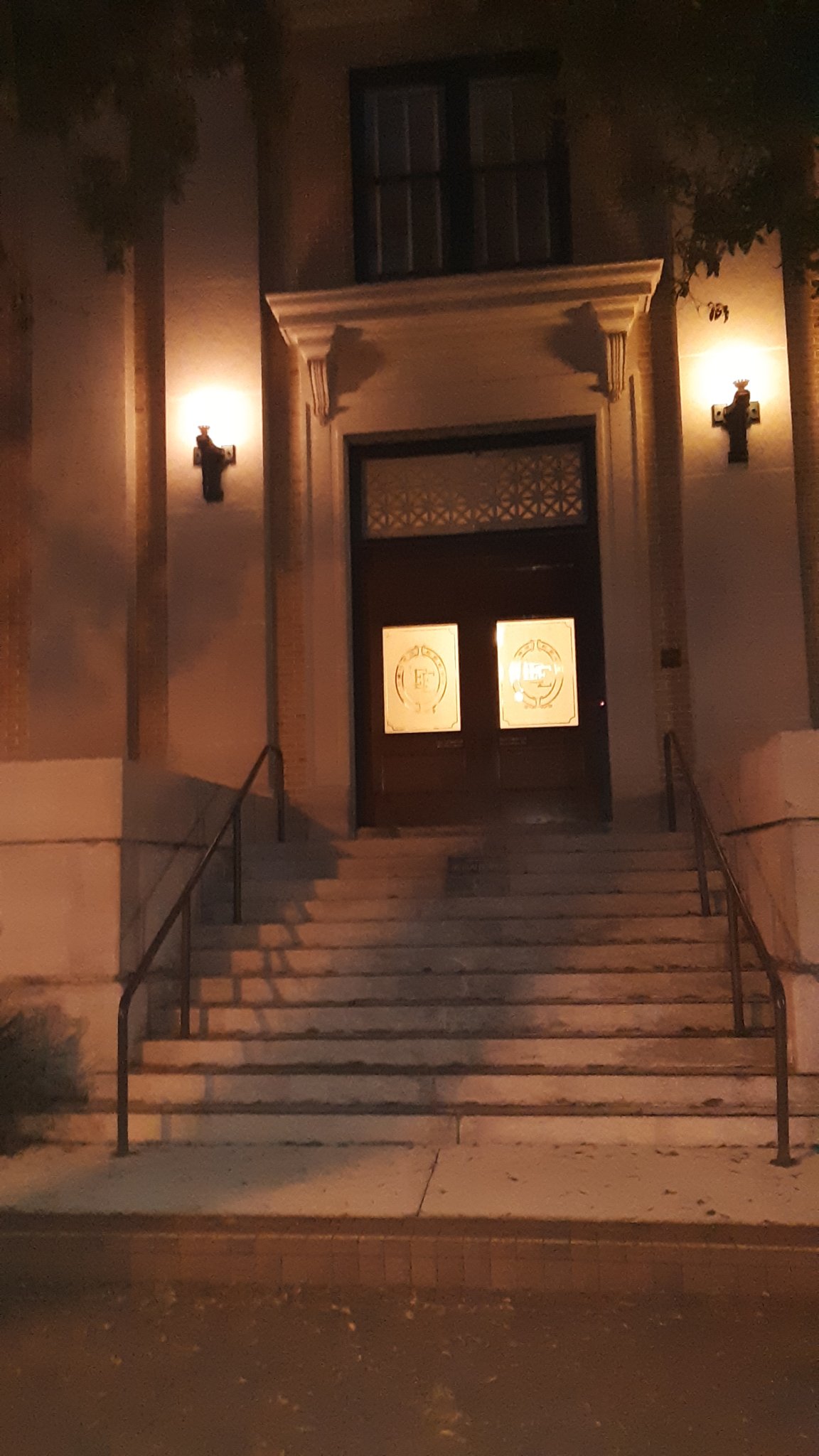
It was built for the Ascher Brothers chain.  The architects were Mark Kalischer and Henry Newhouse.  It was built exclusively as a movie house.  It had one movie screen.  Its capacity was 1,938 seats.

The auditorium had a megaphone shape.  The theater design was Beaux Arts opera house.

In 1940, the Portage was purchased by the Balaban and Katz Chain.  There was renovation of the marquee, lobby, and foyer into an art deco motif.  It remained in operation for years.  In the 1960’s, it began to show Second run movies.

In the 1980’s, it was again renovated.  The movie auditorium was split in two by a wall. Over the years, the Portage was  also managed by ABC Theaters and M & R Theaters.

Portage Park Theater

Portage Park Theater

The Portage was closed between 20001 and 2006.  It reopened in 2006 after another renovation.  The auditorium was reconverted to a single screen.   Seating capacity was 1300 seats.  It exhibited both silent and classic sound films.

The Portage Theater has been home of the Silent Film Society of Chicago and the northwest Chicago Film Society.  It has been a participant in the Chicago Polish Film Festival.


Portage Park Theater

In March, 2016,  Eddie Carranza sold the Portage Theater, the eight storefronts in the theater building and 34 apartments for 2.5 million dollars to BCL Multifamily LLC (part of private equity firm Barnett Capital , LTD).

Unless otherwise indicated, all photos and text are copyrighted.

Copernicus Center Chicago

Copernicus Center

Copernicus Center

Same as above

Copernicus Center

Same as above

Copernicus Center

Inside of Theater Stage

Stage

Side Wall Court

Side Wall

Side Wall Court Wall

Left of Stage

Right of Stage

Right of Stage

Ornamental Ceiling Fixture

     The Gateway Theater is located at 5216 West Lawrence in Chicago in the Jefferson Park neighborhood..

     It opened in June, 1930 for the Balaban and Katz Chain.  Architects were Rapp and Rapp.  It was an elaborate movie auditorium.  There were classical Roman flourishes.   Ceiling was dark blue with twinkling stars ( on a recent visit by the author, there was only one twinkling light).   There were statuaries and vines on the side walls.  It’s capacity was 2092 seats.  It was built to exhibit movies.

     It operated through the 1970’s.  It was later managed by the Plitt Chain and Publix Theaters.

     In the mid 1980’s,  the theater was sold by Plitt to the Copernicus Foundation ( a Polish American Society).  The interior of the Gateway was extensively renovated.   A clock tower called the Solidarity Tower was added.

     The theater hosts community gatherings and live concerts.  In the past, special movie screenings were done.  However, this practice has ceased.