The packet boats on the Illinois Michigan Canal

     Passengers boats on the Illinois Michigan Canal were a common site from 1848–1854.  These boats were known as packet boats (a reference to the packets of mail that they also carried).  However, they also transported oysters, furniture, and retail merchandise.    They travelled between Chicago and LaSalle.    The ticket price was $4.  They were pulled by horses or mules.  They travelled at the rate of 5–6 miles per hour.  Total trip time was well over 20 hours.   Previously this trip was made by stage coach at a speed of 3 miles per hour. 
     Average boat size was 76 x 15 feet.  The boats handled between 90–120 people.
Meals were provided.  Passengers slept on the floor or on shelves. The females were separated from the males by a curtain.  There was obviously no indoor plumbing and a chamber pot was used.  The peak usage of canal boats was in 1848–1852.  Names of packet boats included New Orleans, Illinois, Saint Louis, Queen of the Prairies.  Famous  passengers included A. Lincoln, Walt Whitman, Harriet Beecher Stowe, Charles Dickens, and Nathaniel Hawthorne. 
The packet boat had a short life span on the canal.  They were replaced by the railroads, first the Chicago and Rock Island. The railroads could travel at a faster pace and operated year round.  The Canal was non operational in the winter. 
     An interesting fact is that a replica of the canal packet boat was built in 1908. It docks on the canal in LaSalle near Lock 14.  It has an aluminum hull and a cabin of white cedar.  It measures 76 x 15 ft.  During the spring and summer, mule pulled rides are offered.  The boat travels from its docking site to the aqueduct over the Little Vermilion River and back.  The name of the boat is the Volunteer.

image

The Volunteer.

Hennepin Canal

     This canal was formerly known as the Illinois Mississipi Canal.  It ran from Hennepin to Rock Island.  It was 75.2 miles in length with a 29.3 mile feeder canal from the Rock River in Rock Falls to the canal.  Because of its straight course versus the undulating course of the Illinois River, it shortened the distance between Hennepin and Rock Island by 419 miles.

image

Map Illinois Mississippi Canal and the feeder canal

     There were a total of 32 locks on the main canal.  There was one lock on the feeder canal.  The locks were remarkable for their construction from concrete–an innovation for this time.

image

Lock 26 Hennepin Canal

     There were 9 aqueducts.  There were 67 bridges for highways and railroads ( C,B, & Q RR., Rock Island, RR., Northwestern RR.).

     The Canal was originally proposed as a means to lower rates by providing competition with the railroad.  Coal, salt, grain, gravel, iron and steel were transported through the canal.

image


History

The canal was first proposed as early 1834. However due to financial conditions in Illinois at this time, most public work projects were cancelled or postponed. Pressure to cheapen freight charges led to the U.S. Congress to approve a preliminary survey on the project in 1870.
The survey was supervised by Colonel Wilson, US Corp of Engineers. The survey was actually done by Graham Lowe, engineer and surveyor. His plan was for a canal 160 feet wide and 7 feet deep. The locks were to be 320 X 70 feet. Total cost was estimated to be $12,500,000.
A second survey was was performed in 1882-3. The surveyor was Major W.H. Barnyard, U.S Corps of Engineers. His proposal was that the canal begin at the Illinois River approximately 1.7 miles above Hennepin. He proposed three sites for the terminus of the canal. A board of Engineers was appointed by Congress in 1886 to assess the effects of a canal on national commerce. A favorable report was generated. Their recommendation for the terminus was Marais d’Osier. This was later rejected in favor of Rock Island.
Although multiple surveys had been done and Congress had considered multiple plans, no action was action was taken until 1890. $500,000 was appropriated to begin construction. They still had to make a decision about the course of the feeder canal from the Rock River. Ultimately, Rock Falls was chosen as the site of the origin of the feeder canal.

image

Feeder Canal.

The Hennepin Canal construction began on September 19, 1890. Land acquisition began in 1891. Actual excavation started in 1892. At the beginning of construction estimated cost to complete the project was $6,925,900. There were delays because of the need to build both highway and railroad bridges. Areas of the canal had to be lined with clay to prevent leakage of water from the canal. An innovation was the use of concrete to build the locks. This was a cost saving measure. The locks measured 170 by 35 feet. The Canal was completed on October 21, 1907.

image

Highway Bridge on the Hennepin Canal.

image

Burlington Northern Bridge across the Canal.

The Canal was never as busy as anticipated. There was stiff competition from the railroads for freight. While the canal was under construction, the Army Corps of Engineers widened the locks on the Illinois and Mississippi Rivers. This was a factor in making the canal obsolete before it was opened. The depression also had a profound effect on canal traffic.
While the canal was in service, the Army Corp of Engineers employed 50 men to maintain the canal. Their jobs were to operate the locks and to patrol the banks looking for breaks.
Beginning in the 1930’s, traffic on the canal was primarily recreational. The Canal was also used for swimming and fishing.
On April 7, 1948, the Corps of Engineers issued a navigation notice. This was a warning that there would be only limited service. In 1951, there was suspension of lock operation and non-essential maintenance. In August 1, 1970, full ownership of the canal was transferred to the State of Illinois.

image

Steamboat on the Hennepin Canal

The Irish Canal Workers

     The majority of laborers working on the Illinois Michigan Canal were Irish.  The relationship among the workers was not harmonious.  Specifically, there were persistent tensions between the Corkonians (the Catholics from Cork in southern Ireland) and the Far-downers (Catholics from the Irish Provinces of Leinster, Munster, and Connaught).  This was both a traditional rivalry and one related to the competition for jobs on the canal.
     In 1838, construction on the canal shifted from Ottawa to LaSalle.  This precipitated increased tensions
between the two groups.  In May of 1838, the Corkonians feeling that the best jobs on the canal were being given to the Far-downers engaged in a fight with their rivals in Marseilles.  They were successful in this skirmish.  Emboldened, they marched to the Split Rock region between Utica and the Little Vermillion River.  At this site, they joined with 200 men reinforcements led by a local labor boss–a Mr. Sweeney.  From this site, they moved to Peru destroying every shanty of Far-downers they encountered.
The sheriff of LaSalle County, a Mr. Alison Woodruff, was determined to get this riotous situation under control. He dispatched his deputy Zimri Lewis to recruit men for a posse. Major A. F. Hill and M.E. Hollister led an 80 men posse. They were joined by another group of men led by a canal contractor William Byrne.
The posse was able to locate the Corkonians in a region near Buffalo Rock. They drove them back to Ottawa. They then advanced on the rioters and ordered them to leave. The Corkonians refused and they were subsequently fired upon. They subsequently fled back to the Buffalo Rock region. They were pursued by the posse. Many of the Corkonians fled by swimming across the Illinois River. Approximately 15 men were killed during the uprising.

Illinois Waterway

     The Illinois Waterway System is approximately 336 miles.  It extends from the mouth of the Calumet River to the mouth of the Illinois River at Grafton.  It provides a connection between the Great Lakes to the Missippi River.  A series of 8 locks control the flow of water from Lake Michigan.  The upper lock–T.J. O’Brien is 7 miles from Lake Michigan on the Calumet River.  The last lock is 90 miles upstream from the Mississippi River at the LaGrange lock and dam.  The other lock and dams in the system are: Lockport Lock and dam; Brandon Road Lock and dam(Joliet); Dresden Island Lock and dam( Morris); Marseilles Lock and dam; Starved Rock Lock and dam; Peoria Lock and dam.  The channel is maintained at 9 feet. At the O’Brien lock the waterway is 577 feet above sea level; at the LaGrange lock  it is 430 feet above sea level.
History
The Chicago Sanitary District was established in 1892 to create a solution to the recurrent sewage disposal problems plaguing the city. Basically water in Lake Michigan was contaminated with sewage from the Chicago River. The plan developed was to divert water from the lake and the Chicago River into a new canal. In 1892, work started on the Chicago Ship and Sanitary Canal. It’s goals were to improve transportation, dilute waste and move it downstream. The main channel opened in 1900. It was extended 3 miles downstream of Lockport in 1907. This was associated with the virtual closing of the Summit Division of the Illinois and Michigan Canal. A branch canal–the Cal Sag Canal was constructed between 1911–1922 between the Little Calumet River and the Chicago Sanitary and Ship Canal. This arrangement allowed some deep water shipping. But the new canal only extended to Joliet. Travel on the DesPlaines and Illinois Rivers was not dependable due to the fluctuating depths.
The Illinois General Assembly passed legislation authorizing the Illinois Waterway Project in 1919. This was to provide a channel between Lockport and Utica. This project was started by the State of Illinois; but was ultimately completed by the army Corps of Engineers in 1933. It’s completion resulted in the closure of the remaining Illinois Michigan Canal.

image

Starved Rock Lock and dam

image

image

Peoria Lock and Dam


The Peoria Lock and Dam built in 1938 and the LaGrange Lock and Dam built 1936–9 were not part of the original Illinois Waterway Project.
They were built by the Army Corps of Engineers because of a Supreme Court decision limiting the amount of water that could be diverted from Lake Michigan into the Illinois Waterway.

Atchinson, Topeka & Santa Fe Railroad

     Another one of the minor railroads in the Illinois Valley was the Santa Fe.  Starting in the 1890’s, the Santa Fe travelled south and west from Chicago through Lemont and Joliet en route to Peoria, St.Louis and points west.  In the Chicago–Denver route, it stopped once at Coal City and Lemont and Joliet 5 times.  The Chicago–Peoria–St.Louis route travelled several times a day between Chicago and Joliet.
     The railroad was chartered in 1859.  It was originally organized to connect Atchinson and Topeka in Kansas and Santa Fe, New Mexico.  It was originally known as the Atchinson & Topeka Railroad. After, the completion of its original route, it’s name was changed to the Atchinson, Topeka & Santa Fe
     It expanded both east and west.  It reached Needles,CA. in1883; Los Angeles in1885; San Fracisco in 1900.  It continued its growth through mergers and new construction.  In 1888, it reached Chicago.  By the early 1900’s, it spread south providing service to multiple cities in Texas and Western Louisiana.
     It became efficient in rapidly moving freight between Chicago and other Midwestern cities  and cities on the west coat.
     It became known for its rapid and efficient passenger service.  Lines were known as a the Chief, the Super Chief, Texas Chief, San Francisco Chief, and El Capitan.
     The railroad was quick to embrace new technologies such as autotracks (railroad cars with multiple levels to haul automobiles), piggyback service (trailer on a flat car), inter modal service.
  

image

Santa Fe diesel locomotive

In 1994, the SantaFe merged with Burlington Northern.

Chicago, Burlington & Quincy Railroad.

     A minor player in passenger travel in the Illinois Valley is the Chicago, Burlington & Quincy Railroad.  Two west bound trains stopped in Ottawa en route between Chicago and the western United States.  Two east bound trains also stopped en route from the western United States and Chicago.

image

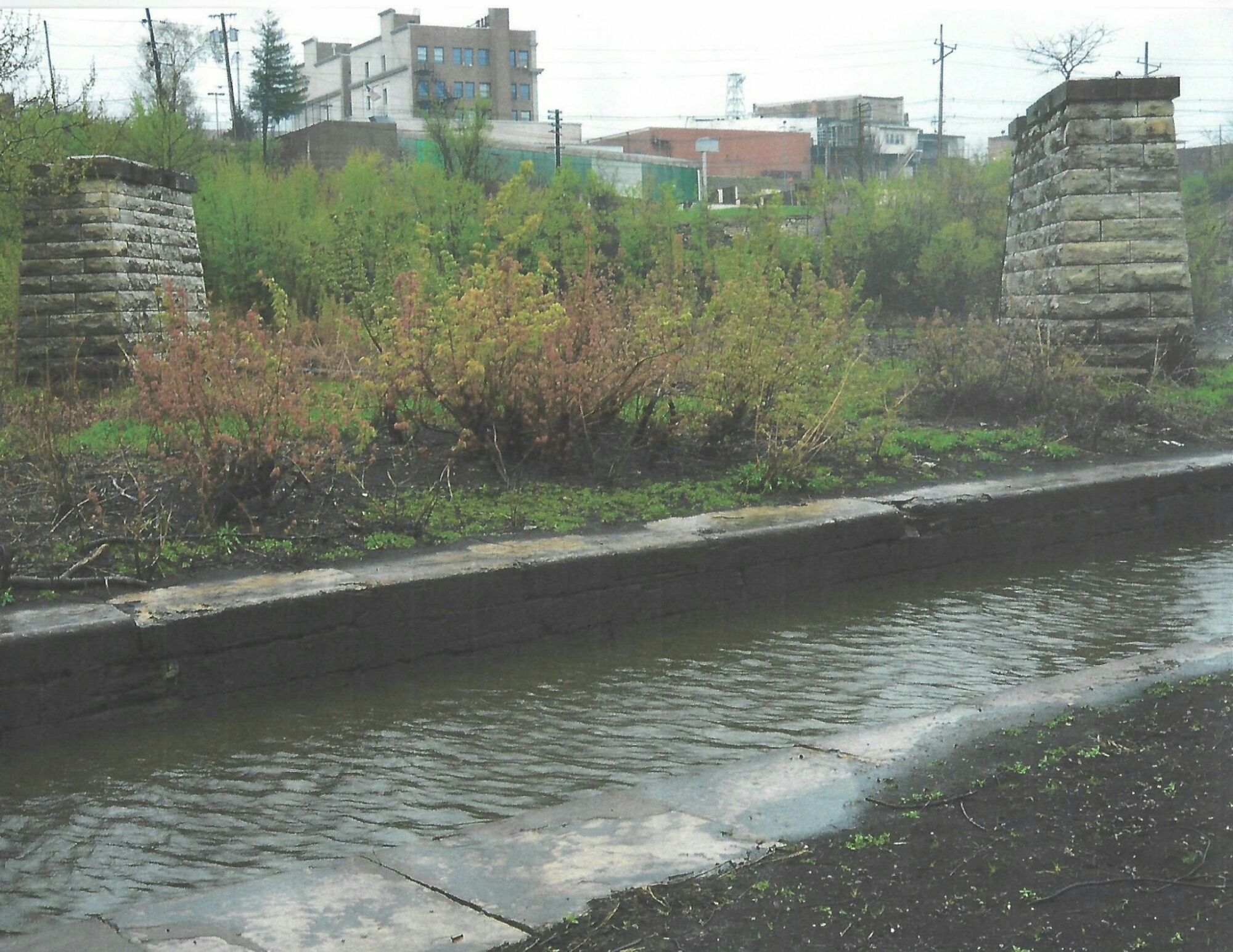
Remnant of the Burlington Bridge Over the I and M Canal LaSalle, Ilinois.

image

Chicago, Burlington & Quincy Railroad

The Burlington began as the Aurora Branch Railroad. In 1849, it was chartered to build a line from Aurora, Illinois to a connection with the Galena and Chicago Union Railroad near West Chicago. In 1852, the name was changed to Chicago and Aurora Railroad. At this time, it was given authority to build a line to Mendota, Illinois where it junctioned with Illinois Central Railroad. On February 14, 1855, it was renamed the Chicago, Burlington & Quincy Railroad. By 1864, the railroad had over 400 miles of track all in Illinois. The track extended to Burlington, Iowa and Quincy, Illinois. In the same year, the railroad built its own line from Aurora to Chicago.
The railroad across Iowa was called the Burlington and Missouri River Railroad and was incorporated in Burlington in 1852. The railroad reached in Ottumwa by 1857; Murray by 1858 and reached the Missouri River in 1869.
In 1868, the C,B & Q built bridges over the Mississippi River both at Burlington and Quincy. These bridges provided railroad connections with the B & MR in Iowa and the Hannibal & St. Joseph Railroad in Missouri.
The B & MR continued building into Nebraska. As a separate entity–Burlington & Missouri River Rail Road in Nebraska, was founded in 1869. In 1870, it reached Lincoln; in 1872, it reached Kearney, Nebraska. In that same year, the Burlington consolidated with B & MR across Iowa. As the Missouri River Bridge at Plattsmouth was completed, the B & MR in Nebraska was approaching Denver, Colorado. That same year, Nebraska B & MR was purchased by the Burlington. The Burlington completed the line into Denver in 1882. This was the first direct rail line between Denver and Chicago.
The Burlington acquired the Omaha and South Western Railroad for access to Omaha. A line to St.Paul was built in 1866. In 1883, the Burlington gained control of the Hannibal & St. Joseph Railroad. In 1894, a line was constructed between Alliance, Nebraska and Billings, Montana.
In 1901, 98% of the Burlington stock was purchased by the Great Northern and the Northern Pacific Railroads. The ultimate mergers of these three companies would take another 69 years.
In 1909, the Burlington gained control of the Colorado & Southern Railway. This provided the company two additional routes–one between Denver and the Gulf of Mexico and a second one between Denver and Wyoming. Other extensions were made to the coal fields of southern Illinois and across the Ohio River into Paducah, Kentucky.
Beginning in the 1930’s, the Burlington became known for its passenger lines–the Zephyrs. These trains were powered by diesel locomotives and had stainless steel passenger cars manufactured by the Budd company.
The following is a list of the Zephyrs Routes:
Pioneer Zephyr– Lincoln–Omaha–Kansas City
Twin City Zephyr– Chicago– Minneapolis/ St. Paul
Mark Twain Zephyr–Saint Louis–Burlington, IA
Denver Zephyr–Chicago–Denver
Nebraska Zephyr–Chicago–Lincoln, Nebraska
Sam Houston Zephyr–Houston– Dallas/Fort Worth
Ozark State Zephyr–Kansas City–St.Louis
General Pershing Zephyr–Kansas City–St.Louis
Silver Streak Zephyr–Kansas City–Omaha–Lincoln, BE.
An Sat Ben Zephyr–Kansas City–Omaha–Lincoln, NE
Zephyr Rocket–St.Louis–Burlington–Minneapolis/St. Paul
Texas Zephyr–Denver–Dallas/Fort Worth
American Royal Zephyr–Chicago–Kansas City
Kansas City Zephyr–Chicago–Kansas City
Exposition Flyer– Chicago–San Francisco
California Zephyr–Chicago–San Francisco

image

Burlington Zephyr

These routes began to be discontinued with the emergence of Amtrak.
In 1970, the Burlington, Great Northern, Northern Pacific, and the Spokane, Portland, & Seattle merged to form the Burlington Northern Railroad. In 1995, the Burlington Northern merged with the Santa Fe forming the Burlington Northern Santa Fe.
The Burlington developed multiple innovations including: Vista dome passenger cars, stream lined passenger diesel power, printing telegraph, and train radio communication.
Next Atchinson, Topeka & Santa Fe.

Illinois Central Railroad.

     One of the lesser railroads in the Illinois Valley was the Illinois Central.  It was known as the main line of mid America.  This train stopped en route to either Cairo in southern Illinois or Dubuque, Iowa.
     In 1850, President Millard Fillmore signed a land grant to build the railroad.  This was the first land grant railroad in the United States.  The Illinois Central Railroad was chartered by the Illinois State Assembly in 1851.   An investment of 27 million dollars from European investors was needed to begin construction.  The line between Cairo and Galena was completed in 1856.
A branch line between Centralia and Chicago was completed in 1855.  In 1867, lines were extended into Iowa.  In the 1860’s and 1870’s, the Illinois Central acquired and expanded into the south.  It’s coverage went to New Orleans in the south and Louisville in the east.  In 1880’s, northern lines were built to Dodgeville, Wisconsin; Sioux Falls, South Dakota; and Omaha, Nebraska.
     In 1972,  the IC merged with the GMO to form the Illinois Central Gulf.  In the 1980’s, the combined line operated 13,532 miles of track.  Later in the 1980’s, the railroad spun off most of its EW lines and many of its redundant North South Lines.
     In 1988, it’s name was changed back to the Illinois Central Railroad.  In February, 1998, the Illinois Central was purchased by the Canadian National Railroad.
     The major passenger lines were: Chicago to New Orleans; Chicago to St.Louis; and Chicago to Omaha.

image

Chicago, Alton & Saint Louis Railroad.

     The era of the packet boat passenger service on the Illinois Michigan Canal lasted between 1848 to 1854.  It was replaced by rail service in the Illinois Valley.  Rail service was more rapid and ran year round.  One of the earliest rail lines was Chicago, Alton & Saint Louis.

image

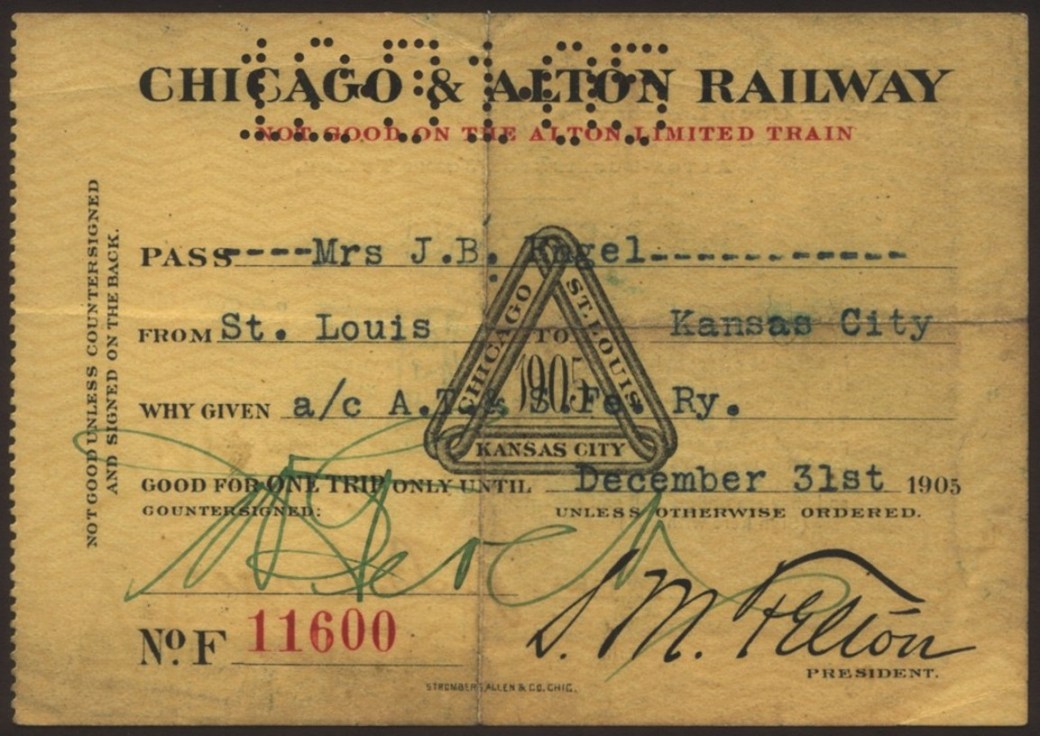
     The Alton & Sangamon Railroad was chartered by the State of Illinois in February of 1847.  It was to be a connection between the agricultural area near Springfield, Illinois and Alton on the east bank of the Mississippi River.  It was completed in 1851.    Subsequently, it was extended north through Bloomington to Joliet.   It was renamed the Saint Louis, Alton & Chicago Railroad.  The Chicago & Alton Railroad was organized in 1861  to purchase the Saint Louis, Alton & Chicago Railroad.  In 1864, the C & A leased the Joliet and Chicago Railroad.  This provided an access to the Chicago area.  A Mr. Timothy Blackstone (president of the J &C) also became the president of the C & A.  In 1870, the C & A leased the Louisiana Missouri River Railroad (Louisiana, Missouri to the north bank of the Missouri River opposite Jefferson City) and in 1878, it leased Kansas City, Saint Louis & Chicago Railroad (Mexico, Missouri–Kansas City).  This resulted in the shortest Chicago–Kansas City Route.
Toward the end of the the 19th century, there was active interest by many parties to purchase the Chicago & Alton Railroad. E.H. Harriman
image

was able to form a syndicate of railroad financiers that successfully arranged the sale. The C & A Railroad became reincorporated as the C & A Railway on April 2, 1900; this was done to arrange a take over of a line from Springfield to Peoria. The following day it leased the C & A Railroad. Ultimately, the two lines were consolidated as the C & A Railroad in1906.
In 1904 control passed to the Union Pacific Railroad and the Rock Island, and in 1907 to the Toledo, Saint Louis & Western Railroad (part of the Nickel Plate). Beginning in 1912, the C & A began multiple years of deficits. In 1922, it entered receivership. It was purchased and operated by the B & O until 1943. It ultimately became part of the G, M & O in 1947. It operated under this arrangement until 1972. In 1971, passenger service was taken over by Amtrak. From 1972–1987, Alton merged into Illinois Central Gulf. In 1987 Alton Joliet–St. Louis was sold to the Chicago Missouri and Western. In 1989, CM & W acquired by UP. In1990, St.Louis ( & Springfield) to KC sold to Gateway Western Railroad. 1998 Canadian National purchases Joliet–Chicago portion of old Alton. Passenger service operated by Metra. In 1997, KCS obtains St. Louis–KC line from Gateway Western.
The C& A was one of the primary trunk railroads for travel inside and beyond the canal corridor. It’s route paralleled the I and M canal between Chicago and Joliet. It passed the coal fields south of Joliet before heading onto Saint Louis. It’s passenger service improved in the 1880’s and 1890’s. There were 4 daily trains in each direction between Chicago and Joliet in 1881. 5 in each direction in 1884. 6 outbound and 8 inbound in the 1890′ s. Stops included Sag Bridge, Lemont, Mount Forest, 23rd Street (Chicago), Bridgeport (Chicago), Brighton Park (Chicago), Summit, Willow Springs, Lockport, Coal City, Joliet. Trunk lines provided service to Saint Louis and Kansas City.

Chicago, Ottawa and Peoria Railway

Running along the Illinois Valley between Joliet and Princeton was the Chicago, Ottawa and Peoria Railway.  It was one of the largest  interurban electric lines in the state of Illinois.  It was also unique in that it was an isolated section of the Illinois Traction System.  It was originally intended to be a part of the proposed Chicago–Peoria–Saint Louis system.
     This rail system was incorporated in 1902 as the Illinois Valley Traction Company.  It was acquired in 1904 by the Illinois Valley Railway Co.  It was acquired in 1909 by Western Railway and Light Co. as a subsidiary Chicago Chicago, Ottawa and Peoria Railway Co.  In 1913 it became a subsidiary of Illinois Traction Co.  In 1924, a subsidiary Illinois Power and Light Co. was formed to operate the railway.
     The railway was constructed in stages.  The first section was constructed in 1904 from Ladd through Peru and LaSalle to Ottawa.  An extension from Ottawa to Marseilles was completed later in 1904.  Two years later, the line was extended west from Marquette to Princeton and east from Marseilles to Seneca. Eastward construction reached Morris in 1909;  Joliet in 1912.  Here it connected with the Chicago and Joliet Electric Railway.  A branch to Streator was built in 1908.
     In 1924, the cars were modernized from wood to lightweight steel coaches.  The line was predominately a passenger service with little freight.  Beginning in the late 1920’s to the 1930’s there was a gradual discontinuation of service.
     Service Joliet–Morris discontinued 1934.
     Service Morris–Seneca discontinued 1934.
     Service Seneca–Marseilles discontinued 1934
     Service Marseilles–Spring Valley discontinued 1934
     Service Spring Valley–Ladd discontinued 1924
     Service Spring Valley–Depue discontinued 1934
     Service DePue–Princeton discontinued 1929
     Service Ottawa–Streator discontinued 1929.

image

Illinois Valley Interurban

Chicago & Joliet Electric Railway

     The Chicago and Joliet Electric Railway was an electric interurban railway between Chicago and Joliet.  It was the only interurban between these cities.  This provided a link between the streetcar network in Chicago and the cities along the Des Plaines River Valley in north central Illinois.  This was serviced by the Illinois Valley Division of the Illinois Traction System.
     This is the history of the system.  In 1885, Joliet Street Railway Co. introduced horse car service.  In 1892, the first electric streetcar service was operated by the Joliet Street Railway Co.  In 1896, Joliet Railway Co . incorporated, acquiring Joliet Street Railway Co.  In 1898, Joliet Railroad Co. incorporated, acquiring Joliet Railway Co.
     In 1901, Chicago and Joliet Electric Railway Co. incorporated, as a consolidation of the Joliet Railroad Co., the Chicago and Joliet Rapid Transit Co.,and the Chicago and Des Plaines Valley Electric Railway Co.,and completing interurban line to Cicero Avenue in Chicago.  The Chicago and Joliet Electric Railway Co. was a subsidiary of American Railways Co.  In1924, Chicago and Joliet Electric Railway Co. sold to Middle West Utilities ( Sam Insull). In 1933 there was the beginning of rail service cancellation.
     Main service lines were between Joliet and Archer  Avenue in Chicago; Lemont and Sag Bridge Cemetery.
     One interesting anecdote concerns an amusement park in Lockport.   This was built in July 4, 1905.  The Chicago and Joliet Electric Railway Co. built this park to promote ridership on the line.  The cost was approximately $300,000.  It operated for 25 years.
Next Chicago Ottawa and Peoria Railway.
image