Joliet the city of stone

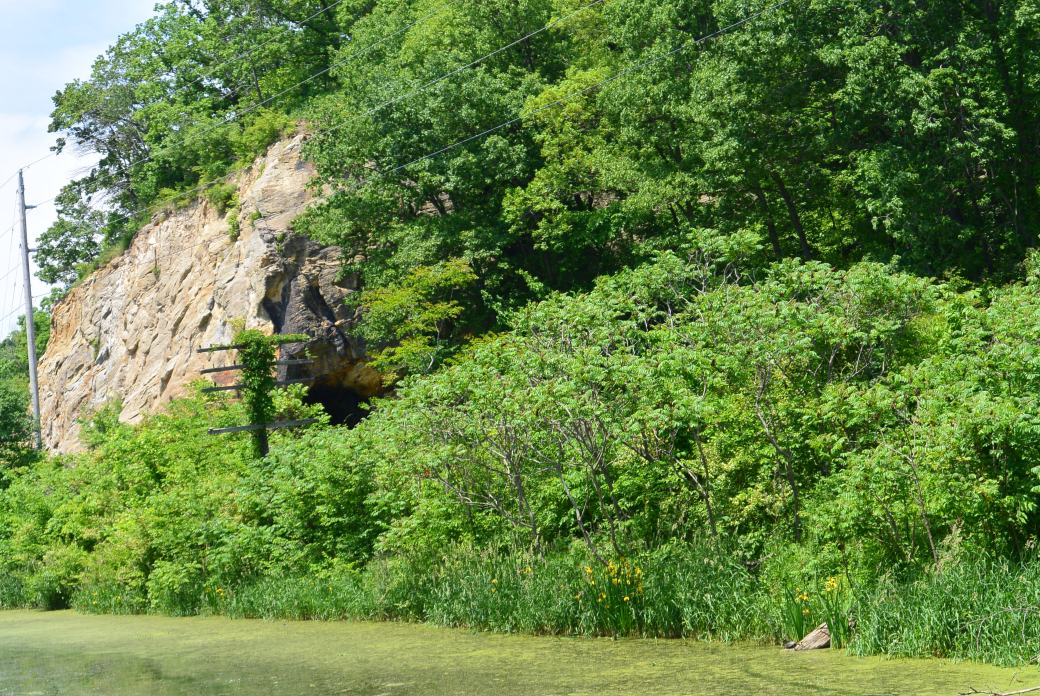
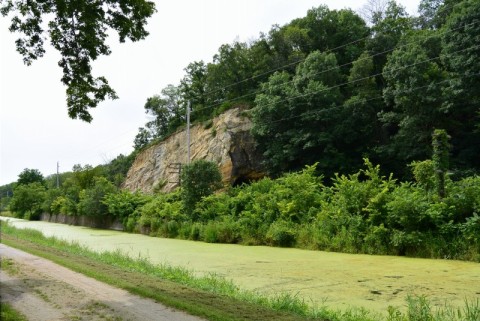
A fortuitous consequence of the route chosen for the Illinois Michigan Canal was the close proximity to multiple sources of limestone.  This construction material was used extensively on the canal.

     The city of Joliet was located in an area of substantial deposits of dolemite (also known as Joliet limestone).  In 1835, Martin Drummond used this limestone to construct a building at the corner of Exchange and Bluff.  There was not extensive quarrying of limestone in Joliet until 10 years later.  At this time, 2 limestone operations opened.  These were Bruce and Company and William Davidson Company.  

    The construction of the Illinois Michigan Canal 1836–1848 provided a stimulus to the quarrying business.  The limestone was used to construct the walls of the locks, the piers of the aqueducts and the bridges.  Later after the canal was completed, it provided a means of transportation to ship the stone to Chicago and other markets.  Later, the railroads provided another means of shipping.

     By 1856, there were 9 quarries in operation producing cut stone for building construction, flagstone for walk ways and landscaping, and rubble for streets and sidewalks.

     In 1870, Sanger and Steele Company was shipping 40 rail cars per week of their limestone products.  After the devastation of multiple buildings in Chicago as a result of the fire of 1871, there was a greatly increased demand for Joliet limestone in the rebuilding projects.

     In the later part of the 1800’s, there was the start of a decline in the sales of limestone in Joliet.  There were many reasons for this. 1) increased competition from the quarries in Bedford, Indiana.  2) increasing use of concrete in building construction.  3) change in architectural styles and tastes.

Chicago Water Tower

Old Illinois State Penitentiary 

Rock Island Arsenal

Illinois State Capital 

Wall Paper Manufacturing in Joliet

Joliet was known for it’s limestone quarries, it’s steel mills, and it’s numerous railroads. A lesser known but a very successful business for years was wallpaper manufacturing.  In the 1900’s, Joliet was a leading manufacturer in this business.  

     Many might wonder why wallpaper manufacturing would flourish in the Joliet area.  There were a number of reasons for this:1) it was near many large markets; 2) there was a large labor pool; 3) there was a well established transportation net.  This included railroads, water (I and M Canal, Chicago Sanitary and Ship Canal), and highways.

     The paper was shipped from Maine, Michigan and Wisconsin.  The clay used for mixing colors was shipped from Georgia. 

     At one time, there were 6 separate wall paper companies in Joliet.  They were:  Star Peerless Wall Paper Company, Joliet Wall Paper Mills, Lennon Wall Paper Company, Midwest Wall Paper Mills, Superior Wall Paper Company, and the United Wall Paper Factory.  

     The first company was Star Peerless. It began in 1907.  It’s founder was Frank Kelley.  He originally had an operation in Chicago.  He moved to Joliet as a cost saving measure.  He originally set up a wall paper machine in a loft.  He eventually built a plant on Maple Street.  His company was very successful.

     The next company to open in Joliet was Joliet Wall Paper Mills.  It incorporated in 1914. The original president was Charles Nowell.  The plant was located on  4 acre site.  It had 150 employees. The plant was 240 X 550 feet.

Mount Joliet

Mount Joliet

     A striking example of the negative effects of human activity on nature is the history of Mount Joliet.  This hill like area was variously known as Mount Juliet, Mount Joliet, Mound Juliet or Mount Joliet.  

     This hill was located in the area between I 80 and US 6 south of Joliet near the DesPlaines River. It was 450 yards long and 60 feet high. It was created by the activity of the Wisconsin Glacier.  It was composed of clay and gravel.   Native Americans inhabited the Mount for hundreds of years.  In the 1670’s, Marquette and Joliet discovered this site and camped there.  French Canadiens voyageurs used this as a landmark for their travels    Starting before the Civil War, a company named Joliet Mound Drainage Tile Company began a quarrying operation on the Mound for its clay and gravel.   The company manufactured tiles and sewer pipes.  The gravel was used for fill and railroad ballast.  These products were shipped on the I and M Canal.  

The quarrying operation ended in 1912.  The gravel and clay were depleted.  The site of the Mound was now an area of depression.   The local historical society placed a marker near this site at Larkin and Mound Street in Joliet.


Joliet Mound Drain Tile Company

William Gooding


Picture of young William Gooding

Any history of the Illinois Michigan Canal w0uld be incomplete without considering William Gooding, the chief engineer of the project.

     Mr. Gooding was born in Bristol, Ontario County, New York on April 1, 1803. His father was James Gooding originally from Massachusetts. He moved to western New York.  Young William’s education was in public schools and with tutors.  He had no formal education in engineering.  For a while, he worked on his father’s farm.  

     In 1826, he left for Canada.  He secured a job as an apprentice under Alfred Barrett.  The project was the first Welland Canal.  It was a somewhat primitive canal made with wood.  He returned to New York for a short spell managing a store.  It apparently was not a satisfying job.  2 years later he was working as an engineer on the Wabash and Erie Canal. In 1832, he married his wife Ann Marie.  The next year, he left with his wife and infant son Edward for the area around Lockport, Il.  He joined his father and brothers there.

Elderly William Gooding

        His next position was in 1834.  He was hired to head a group of engineers to plot a survey for the Whitewater Canal from Wayne County Indiana to the Ohio River. He also worked on a survey to extend Wabash and Erie Canal.

     in 1836, he received the job as chief engineer of the Illinois Michigan Canal.  It should be noted that none of the engineers working on canals during this era had formal education.  It was all on the job experience.  These individuals all pretty much new each other.

     As chief engineer, Gooding was responsible for setting the specifications of the canal itself as well as for the locks. He determined their placement.  He supervised the work of the various independent contractors.  He was also responsible for reporting problems and progression of the canal project to the board of comissioners.

     When the original plan for the deep cut of the Summit Division had to be dropped due to cost concern, it was Gooding that developed the alternative of the shallow cut.  This new plan involved the addition of 2 locks and the addition of feeder canals.

     He laid out west Lockport. He had the canal towns of LaSalle, Morris, and Channahon surveyed.  He was responsible for the construction of a mill in Lockport in 1836.

       Gooding was particularly interested in the potential of water power specifically between Lockport and Joliet.  There was a substantial drop in the land levels between these two points.   If the canal had been constructed as originally designed, the potential for hydraulic power would have been greater than it was.

     The period between 1838–1844 was a difficult time in the history of the I and M canal.  Money for the project disappeared.  Contractors and suppliers were paid with script with a promise of cash at a later date.   Eventually worked stopped altogether.  During this time, Gooding was under pressure from local politicians.  He was blamed for all of the adversities occurring during this period. This despite the fact that most of these were not under his control.  Eventually, alternative financing was secured for the project and the canal was completed in 1848.  Despite this, Gooding was dismissed that same year by Illinois governor French.    However, the canal comissioners ( they apppreciated the work of Gooding) appointed him Secretary of the position.  This was an important job.  He held this until 1871.

     In this same year, Gooding was hired by the city of Chicago to help design a deep cut in the Summit division of the canal (ironically this was supposed to be the original design of the canal).    The purpose of this project was to reverse the course of the Chicago River and result in the Chicago sewage being sent down the canal and into the Illinois completed.  When the project was completed, two summit locks were eliminated.  

     Ultimately, this project proved to be inadequate for its stated purpose.  The result was the construction of the Sanitary and Ship Canal.  

     Gooding’s health failed in the 1870’s.  He died on March 4, 1878.  He left 2 sons and 5 daughters.  

 Grave marker William Gooding

E. Porter Brewing Company

     A well-known figure in Joliet in the last half of the 1800’s was Edwin Porter.  He was born on April, 19, 1828 in Granger, Medina County,  Ohio.  He married Almenia Abigail  on December 27, 1856.  He and his wife came to Joliet, Illinois in the same year.  

     In 1858 Porter entered the brewing and the malting business.  He established his brewery near the DesPlaines River.    His products included lager beer, ale and london porter. His lager was marketed locally.  His ale and porter had a more widespread distribution.  The water used in brewing came from deep artesian wells.

     He became very successful.  His brewery was the largest in Joliet.  It was one of the largest in the state of Illinois.   In 1866, he constructed a 3 story building for his company.  Later additions were made to this building.  In 1893, the brewery was incorporated and the name was E. Porter Brewing Company.  This was in operation until the time of Prohibition.  

     In addition to being a business man, Mr. Porter was civic minded.  He served as mayor of Joliet from 1879-1883; 1864-6; and 1871-2.  He died on March 13, 1909.

Y

Porter Brewing

Jeremiah Crotty

wpid-wp-1442527223133.jpeg

Seneca Grain Elevator

scan_0011

Rock Island Station Seneca
The history of the Illinois Michigan Canal is filled with many colorful and interesting characters.  One such individual is Jeremiah Crotty.  He was born in Cork, Ireland on May 8, 1799.  Due to prevailing financial conditions in his native country he decided to migrate to the United States. He left from Cork on the Barque George Canning.  It arrived in New York on June 5, 1828.   His occupation on the ship  manifest was listed a a laborer.  His  early life was somewhat nomadic.  He spent one year in New York; 8 years in Pennsylvania; and 3 years in Maryland. It was here that he met and married his wife–Ellen Blake.

From Maryland, he made his way to the Illinois Valley Region.  No doubt he did this because of the construction jobs available on the I and M Canal.   In 1838, he made his way to Lockport with the intention of making bids on canal construction jobs.    This despite the fact that he had zero experience and zero references.  Some how he was able to obtain financial backing.  He developed a new technique to excavate the soft sandstone in the portions were he worked.    He obtained contract work on the I and M canal between Aux Sable and Otttawa.  In the period of 1841 to 1842, when work was suspended on the canal, he did contract on the Rock Island Railroad out of Minooka.     Later when construction resumed on the canal, he did construction work on it.    For a short period of time, he did contract work on the Northwestern Line in Elgin.
He returned to the Illinois Valley in the area that would become Seneca in 1848.  He constructed a home in 1849.  Contractors were Higgins and Clark (carpenters) and R. Cosgrove (masonry).   In 1857, he laid out a town of the bluff.  In 1858, it was incorporated as a village with the name of Seneca.    He sold lots for a dollar.  By 1860, there were 15 homes and 2 stores.  The Rock Island Line ran through the town.  Depot was built in 1854.   Crotty’s son was hired as the first train agent.  A smaller train  line the Seneca and Kankakee also served the area.
During the remainder of his life, Crotty remained active in town business and government.  He died on July 28, 1879 leaving a wife and children.
Seneca was incorporated as a city in 1957.

scan_0014

Letter from Jeremiah Crotty to the Canal Commission.

Joliet Railroads.  Elgin Joliet & Eastern Railroad

The Elgin, Joliet and Eastern Railway was a fairly successful company for many years.There were two main reasons for this:

One.  It filled a niche by providing a by-pass arc outside the Chicago area for freight transport.  It began in Waukegan and proceeded  south and west near Elgin and Aurora.  It then proceeded east to Joliet and Dyer.  From  here it traveled north to Gary and the along the lakeshore to Whiting and South Chicago.

Two. It concentrated on providing freight service to industrial businesses such as the steel industry.

The railroad resulted from mergers and consolidation of multiple companies.  It’s earliest predecessor was (1887) the Joliet and Northern Railroad.  This road offered freight and passenger service between Joliet and Aurora.  In 1888, 2 companies were set up to build a railroad that would form a by pass around Chicago and into Indiana.   The names of  the two companies were Elgin, Joliet & Eastern of Ilinois and the Elgin, Joliet & Eastern of Indiana.  In October, 1888, the E, J & Illinois acquired the Joliet & Northern.  In December, 1888, the two E, J & Eastern lines merged to form the Elgin, Joliet & Eastern R.R.

For years after, the J. Company continued to develop and expand its Chicago belt line.  It did this by laying new track and my merging with smaller lines.  Among these were Gardner, Coal City, and Northern RR., the Waukegan and Southwestern Railroad, and the Chicago, Lake Shore and Eastern Railroad.

The J line was known predominately for its freight service.  However, for a brief period, it offered passenger service.  It had a depot in down town Joliet on Clinton Street.  This service ended in 1907.

For years, the line had an association with the steel industry.  Illinois Steel purchased the line in the late 1800’s.  In the 1890’s, it became a part of Federal Steel and in 1901 U.S. Steel.

The Joliet Division of the line included the East Joliet Yard.  This was a large complex containing a round house, a machine shop, blacksmith shop, locomotive shop and cinder pits.

The J line for years was a major employer in the Joliet area.  At its peak in 1951, it employed 5,900 employees and its freight business generated 55 million dollars in revenue.  Today the line employs approximately 750.


KONICA MINOLTA DIGITAL CAMERA

E, J & Easter Railroad Bridge over the Calumet River


eje_map_sm

Map of the J. Line

In 1988, U.S. Steel and the Blackstone Group formed a holding company Transtar, Inc. to serve as shareholders of the E,J & E Railroad and several other affiliated companies.  In March, 2007, Blackstone ended its interest in Transtar.  It then became a subsidiary of U.S. Steel.

On 1/31/2009, CN purchased the J line.  Its plan was to use the railroad as a by pass of the congested Chicago rail system.   Transtar retained the facilities in Gary.  These were reorganized to  form the Gary Railway serving U.S. Steel.

Freight Yards

Carus Chemical Company

scan_0009

Carus Chemical Company     

Carus Chemical was founded in 1915 by Dr. Edward Carus.  He was born in LaSalle, Illinois in 1890.  He received a degree in Chemical Engineering in 1912 at the University of Wisconsin.  In 1912-13, he studied at Cambridge.  He did post-graduate studies at the University of Goettingen in Germany.  For a year (1914-1915), he taught at the University of Kansas at Lawrence.  He then returned to LaSalle.

The Carus Plant is located on 8th Street in LaSalle.  It was set up to provide a supply of potassium permanganate.   There was a shortage of this material during  World War 1. The company specializes in manganese products such as permanganates and magnesium oxides.   At one time Carus also produced hydroquinone (photography developer) and manganese sulfate (used in fertilizer in the citrus industry.  However, these two products have not been manufactured since the 1970’s.

During his presidency, Dr. Carus concentrated on optimizing and stream lining production.  He was successful in this goal.

Edward was succeeded by his sons Blouke and Paul in the late 1950’s.  They concentrated on modernization and expansion of markets.   They concentrated on their core product permanganates.     These are powerful oxidants.  They have may uses:  1) organic synthesis; 2) purification of air, drinking water, and waste water; 3) descaling of metals; 4) manufacturing of printed circuit boards.

The two brothers were successful in creating new markets. They established mergers with Technical Products Corp., Kjell Corp., Industrial Quimica del Nalon of Spain.


Ottawa Toll House

scan_0005

Ottawa Toll House


In Ottawa,on the bank of the Illinois Michigan Canal near Columbus Street, there stands the only remaining toll house of the Canal.  It was likely built around 1848.    Tolls were collected here.  One toll was for the canal boat and a second toll was for the cargo.   Near the building, there was a low lying swing bridge which prevented boats from leaving this area until the toll was paid.  These tolls were used to pay off the construction bonds and the upkeep of the canal.    The toll house closed in 1926.  One of its many uses was a barber shop.  It current appearance was from refurbishment.  It apparently resembles the 1910 appearance of the toll house.