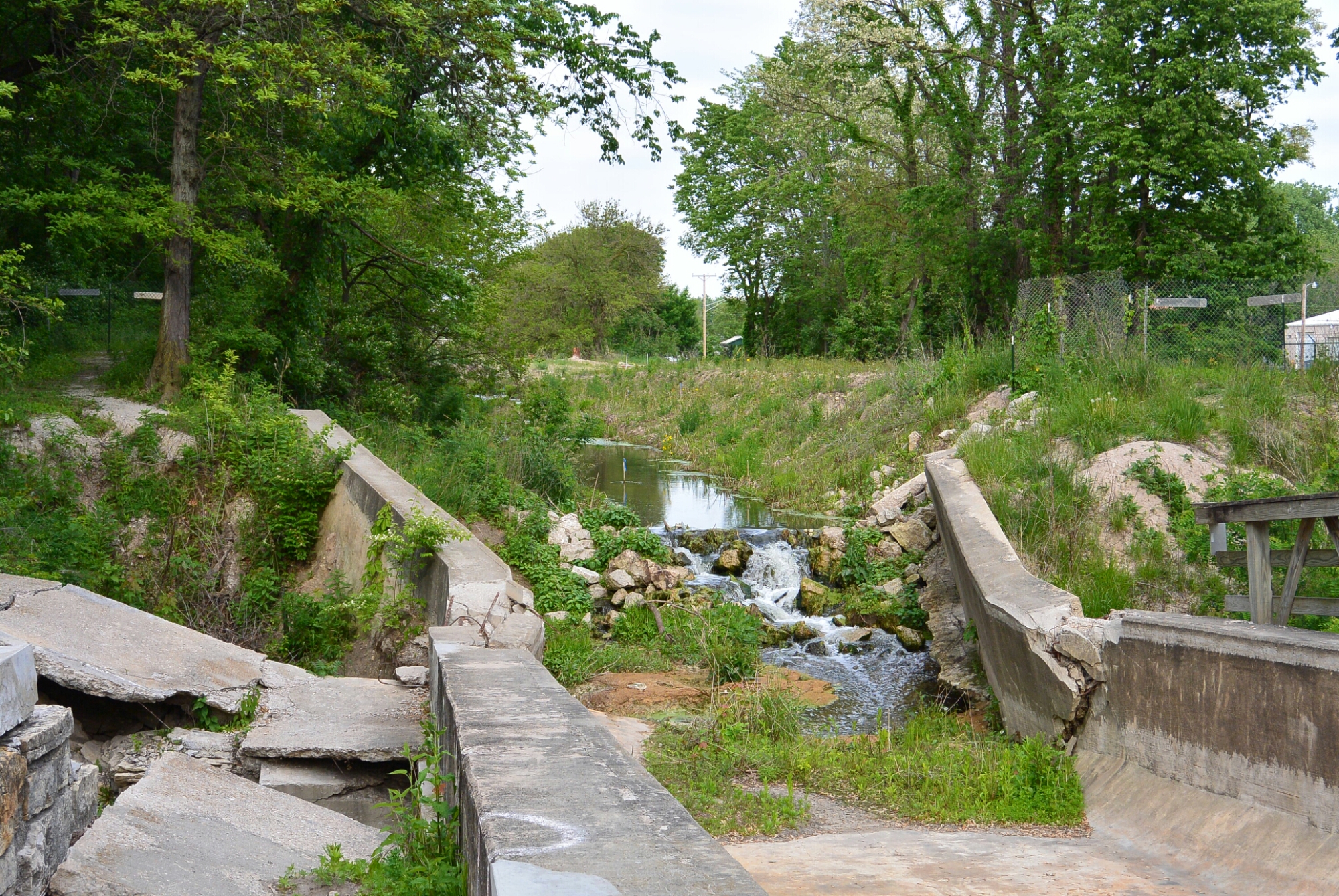
Top photo current photo Nettle Creek Aqueduct.
Bottom photo current state of the Illinois Michigan Canal Gebhard Woods State Park
Located just off Ottawa Street in Morris, Illinois is Gebhard Woods State Park. This 30 acre site was originally owned by Mrs. William Gebhard (the beer brewing family). It was subsequently purchased by the Grundy County Rod and Gun Club in 1934. Sale price was $1500. A game fish rearing pool was added to the site by the club. Subsequently, the property was donated to the state to be maintained as a park.
During the depression several improvements were made by the CCC. The landscape was cleared. Two additional spawning pools for fish were constructed. Hiking trails were developed. Multiple shelters were constructed.
The park is bordered on the south by the I M Canal. Currently there is little water in the canal; it is weed filled. On the north border is Nettle Creek.
At the site where the canal crosses Nettle Creek is the aqueduct. This was originally constructed in 1847. It has been rebuilt several times. In April, 2013, the aqueduct collapsed during a severe rain storm. It has remained in this state ever since.
Uncategorized
Financing of the Illinois Michigan Canal
A common problem in the history of canal construction in the United State States in the 1700’s and 1800’s was the lack of adequate financing. Private financing was typically a failure due to the size of the canal projects. Attempts to involve the federal and state governments were met with mixed success.
Many projects once started either were never finished or completed in a modified fashion.
Similar problems faced the Illinois Michigan Canal. The first bill authorizing the I M Canal in Congress in 1822 provided the land needed plus 90 feet on both sides of the canal. Several attempts to raise the necessary capital to begin construction were failures. A second bill in Congress in 1827 increased the size of federal land grants on both sides of the canal. The intention was that this land could be sold to provide funds for canal construction. However, in 1830–1832, land sales totalled $18,799; expenses were $14,700. At least some individuals were having second thoughts and leaned to construction of a railroad. A bill passed in Congress in 1833 allowed for the use of federal land to build a canal or a railroad. State legislature reaffirmed the decision to build the I M Canal. In 1836, the state of Illinois floated a $500,000 bond issue to provide funds for canal construction.
Finally, construction began in 1836. Construction continued until 1841 despite financial panic of 1837. The state was forced to use creative financing–selling junk bonds and paying contractors with scrip promising to pay owed money plus interest when the state obtained the money. Finally, all construction ceased in 1841 when the state defaulted on interest payments on bonds. Construction did not resume until 1845.
The deep cut revisited
The original plan for the Illinois and Michigan Canal called for a so called “deep cut” in the Summit Division. This was the section from Bridgeport (at the eastern most canal at its origin) to Lockport. The reason for this was to reverse the flow of the Chicago River into the canal to provide a water source.
As the construction of the canal ground to a halt because of financial difficulties, an alternative plan was proposed by the chief engineer William Gooding. This new plan was the shallow cut. This would be a less costly alternative and would help in the completion of the canal. This plan consisted in less deep excavation of the Summit Division. Two additional locks were constructed–one at the junction of the Chicago River and the I M Canal; the second three miles north of Lockport. At Lock 1, there was a steam driven pumping station. This pumped water from the Chicago River into the canal. A feeder canal was constructed constructed from the Calumet River to the I M Canal. This was an additional water supply. The date of the completion is confusing. Some state 1552 others 1848–1849.
In the 1860’s, the city of Chicago was growing rapidly in population. As a result of this, there was contamination of the water supply from Lake Michigan. Contaminated water flowed from the polluted Chicago River into the lake. There were outbreaks of cholera from this contaminated water supply.
When solutions were being proposed for this problem,once again William Gooding showed up as a consultant. Ironically,his proposal was a deep cut in the canal from Bridgeport to Lockport. This would reverse the course of the Chicago River and water and its pollution would flow into the I M Canal. Locks 1 and 2 were removed. The Calumet feeder canal was closed. All this work was completed in 1871. This proved to be a temporary unsatisfactory solution. Ultimately this was replaced by The Chicago Sanitary and Ship Canal. But this is a story for another blog
Mathiesssen and Hegeler Zinc Company (Revised)
Probably one of the premier manufacturing companies in LaSalle in the 1850’s to the 1970’s was the Matthiessen and Hegeler Zinc Company. This was founded by Edward Hegeler and Friederich Matthiessen. These two men met in Germany while attending the Freiberg Mining Academy in Saxony. They were trained as mining engineers and metallurgist. They recognized the potential opportunities for the Zinc Industry in the United States. With this potential business plan in mind, they migrated to the United States in 1856.
In 1858, Matthiesen was studying the zinc industry in Wisconsin. Hegeler was in LaSalle investigating coal opportunities. They eventually chose LaSalle as the site for their Zinc smelting plant. Several factors affected their decision: 1) nearby transportation modes ( the railroads, the Illinois Michigan Canal, and the Illinois River). These were needed to provide access to the ore and to deliver their finished product; 2) Accessible coal and zinc ore deposits.
Construction began in December of 1858. The smelting foundry was completed in 1860. In their process, they used a Belgian type smelting furnace. In 1866, zinc rolling mill was built to produce sheet zinc. They incorporated as Matthiessen and Hegeler Zinc Company in 1971.
In order to process zinc ore, large quantities of coal were needed. It was because of this need that the company purchased coal rights in the areas around their plant. They also brought experienced miners from England, Scotland, Wales, and Austria to work the mines.
In 1881, Edward Beveledr developed a furnace that trapped the sulfur fumes and generated sulfuric acid. This was an efficient system that decreased coal use. Thus the company also became a producer of sulfuric acid.
Matthiessen Hegeler became a big player in the zinc industry. It held this position for years.
They also were known for the positive relations that they had with their employees.
In 1924, the Hegeler Carus family bought out the Matthiessen family. Like many other local businesses, they were negatively affected by the depression. It was not until the 1950’s that there was a resurgence in the business. M and H obtained interests in eastern states. They purchased two large processing and manufacturing plants. Money problems and foreign competition had a negative affect on the business. In 1961, zinc smelting was ended. Sulfuric acid manufacture ended in 1968. Their was a brief unsuccessful attempt to switch to aluminum manufacturing in the 1970’s. However, the company ceased operations in 1978.
A black mark on the facility in later years is a designation as a site of contamination by the EPA.
The Summit Division of the I M Canal 1860’s to 1900’s.
Chicago after the end of the Civil War was experiencing many of the problems facing big cities at this time. One of the most important was preserving a clean water supply. The city received its water from Lake Michigan. Cribs were built away from the shoreline to establish fresh uncontaminated water supply. Despite this measure, it was not unusual for water from the Chicago River to back up into Lake Michigan after a heavy rain fall. At this time, the river was used as sewer to dump garbage and waste. Consequently, the lake would be contaminated after each of these back ups.
The solution to this problem proposed by local authorities was to deepen the cut of the I’M canal to Lockport where there was an intersection with the Des Plaines River. This would reverse the flow of the Chicago River to the I M Canal. Problem solved. Not unexpectedly, there were objections from residents of downstate Illinois and the Illinois Valley who did no want to contend with pollution from Chicago. Surprisingly,the Illinois General Assembly gave the city the authority to complete this project in February of 1865.
The project was completed in stages usually during the winter when the canal was usually closed. It was ultimately completed in 1871 for approximately 3 million dollars. The city was later partially reimbursed by the state.
With the ever increasing population of Chicago the canal was unable to handle the increased volume of pollution. There was recurrence of the problem of contamination of the Lake Michigan water supply.
In 1889, the Chicago Sanitary Commission was formed to find a solution. It’s project was a new larger canal from the Chicago River to the Des Plaines River at Lockport. The Canal was 28 miles. It was named the Chicago Sanitary and Ship Canal. It’s construction began September, 1892. It was completed January, 1900. With its completion, the eastern I M Canal became obsolete and was subsequently closed to navigation permanently.
Canal Construction 1836–1848
On July 4, 1836, a gala celebration at the south branch of the Chicago River marked the official start of construction on the Illinois Michigan Canal. However, in the first year, construction was hampered by weather and lack of manpower and equipment. This time was spent in building access roads, acquiring equipment and workers, and building crude structures to house the workers. By 1838, most sections of the canal were under contract.
One complicating factor was the Panic of 1837. This has been attributed to a policy of Andrew Jackson requiring that all federal lands purchased after 8/15/1836 be purchased in gold or silver. As a result of this action, land prices declined; value of stocks and commodities tanked: banks closed ;unemployment increased. This panic took time to reach the Midwest ; but eventually it’s effects were felt. It was possible to continue canal construction using creative financing until 1841. Measures used included: special bonds sold at discounted rates; scrip paid to contractors with a promise to pay face value and interest when funds become available. By the end of 1841, all construction ceased. The state could not meet its bond obligations and defaulted on its interest payments. The value of its bonds crashed to 15 cents on the dollar. In 1842, the Illinois Treasury collected $98,546.00 in taxes and had a yearly expense of $ 800,000 in interest payments. Please note this debt was for all public work projects not just the I and M canal.
In 1842, Governor Ford faced a total debt $15,187,348. With the state assembly he developed a multipoint program to deal with the fiscal crisis. Points included: 1) Modest property tax increase to help fund interest payments on state obligations; 2) dropped all state internal improvement projects except the I M Canal; 3) Proposed the shallow cut plan to complete the canal at a cost of 1.6 million dollars–mounts considerable lesser amount than the originally proposed deep cut. The deep cut was a plan to make the canal deeper than 6 feet in the Summit section in order to provide water for the canal from the Chicago River. The shallow cut cancelled this plan and provided water to the canal with pumps at Bridgeport and additional feeder canals.
General Assembly approved Governor Ford’s plan on 2/21/1843. The Canal was to be managed by 3 trustees. One was appointed by the state. The other 2 were elected by the bondholders of the 1.6 million to complete the canal. The bonds were sold to American and foreign investors.
Work on the canal was resumed in July of 1845. Construction was slow during 1845–1846
Due to many factors. There was a shortage of labor. The weather was poor. After 4 years of abandonment much of the canal was in a state of disrepair. This needed to be corrected.
By 1847, construction advanced rapidly. The Canal was open for navigation on April.10, 1848. First boat through the canal was the General Fry which travelled from Lockport to Chicago.
The Rock Island Line and The Illinois Michigan Canal
Probably one factor that led to the ultimate demise of the Illinois Michigan Canal was the Rock Island Railroad.
The idea of building a railroad between LaSalle and Rock Island, Illinois was first discussed by civic leaders in Rock Island in June,1845. It was felt that this would be a logical overland link between the I M Canal and the Mississippi River. Representatives from Rock Island lobbied state legislators in favor of this initiative. In February 27, 1847, the Rock Island and LaSalle Railroad Company was Incorporated by a special act of the legislature. The members of this company encountered difficulty raising money for this proposal. At that time, it was believed that this difficulty was due to the fact that the rail line was between two waterways and not major metropolitan areas. The organizers subsequently petitioned the legislature for an amended charter to build a rail line between Chicago and Rock Island. The amended charter was approved on 2/17/1851. The new name of the railroad was to be the Chicago and Rock Island.
My personal thoughts here. Did the state legislators ever consider that it might not be a prudent idea to build a railroad paralleling the canal? After all the canal had only been in operation for a few years and the tolls were needed to pay off the bond holders.
Construction on the railroad began in Chicago on 10/1/1851. It was completed to Joliet in October of 1852. It was completed to Rock Island on February 22, 1854.
The first effect on the canal was the end of passenger traffic on packet boats. There was increasing competition on freight tolls.
The railroad had several positive features that worked to its advantage in this competition. Travel by rail was more swift. The railroad operated year round. The Canal was closed in the winter. Railroads could handle most freight expeditiously because the multiple rail lines services reached areas beyond the reach of the canal.
Tolls declined between 1869–1878 because of the competition. The Canal came to be used more for the transportation of bulk goods that did not require speed. This included grains, coal lumber and stone.
Coal Mining in the Illinois Valley
Coal Mining was an important industry in the Illinois Valley 1850’s to the 1920’s. There was a brief resurgence of strip mining in the period from 1920’s–1950’s. The coal mined during this time period was used in local industries . It was also shipped by The I M Canal to more distal sites such as Chicago. The early mines centered around the LaSalle–Peru area. Smaller mining operations were located in the Morris, Marseilles, and the Seneca regions These typically were not long running operations. As these mines became less profitable,they were closed. From the 1920’s to the 1950’s, there were strip mining operations near Braidwood, Morris, Utica and Ottawa.
The coal mining operations fostered industrial development in towns along the canal. Examples of these industries include Matthieson & Hegler Zinc Company in LaSalle; Westclox plant in Peru; Nabisco Plant in Marseilles; Ottawa Silica Plant; National Plate Glass Company at Ottawa; the cement mills near Oglesby. It is true to say that many of these operations would not have been located in the Illinois Valley without the locally available coal for power generation and the I M Canal and railroads for cheap transportation.
Canal in the early 1840’s
Reading the various reports issued by the Illinois Michigan canal commission in the early 1840’s, one can receive an overall impression of the state of completion. No significant work had been performed in years. 4.7 million had been spent and yet much work had yet to be done. Supplies purchased for construction had either been stolen or deteriorated. Sections built had begun the process of deteriorating. The original deep cut plan for obtaining water from the Chicago river was in the process of being abandoned because of cost. Alternate sources of water supply were being considered.
Money was owned to contractors and bond holders. People were paid with scrip and worthless checks. In a word the canal was a disaster. It needed to be completed for the income from tolls; but the money to complete was lacking.
Limestone Quarries
During the years the I and M canal was active there were several limestone quarries along its course. These were located in Lemont, Lockport, and Joliet. The limestone was used in building construction locally, construction of canal locks and more distal construction such as in Chicago. In Chicago buildings such as the water tower,Holy Name Cathedral, and Old Saint Mary’s Church were constructed with this Limestone. The laborers that worked in the quarry were immigrants from many countries; large proportion were from Ireland. The quarries were particularly active after the Chicago fire. They were used in rebuilding the city.
In later years, activity decreased . This was from competition from limestone mined in Indiana. This was considered a more durable product. The Illinois quarries were relegated to producing crushed rock.