The Elgin, Joliet and Eastern Railway was a fairly successful company for many years.There were two main reasons for this:
One. It filled a niche by providing a by-pass arc outside the Chicago area for freight transport. It began in Waukegan and proceeded south and west near Elgin and Aurora. It then proceeded east to Joliet and Dyer. From here it traveled north to Gary and the along the lakeshore to Whiting and South Chicago.
Two. It concentrated on providing freight service to industrial businesses such as the steel industry.
The railroad resulted from mergers and consolidation of multiple companies. It’s earliest predecessor was (1887) the Joliet and Northern Railroad. This road offered freight and passenger service between Joliet and Aurora. In 1888, 2 companies were set up to build a railroad that would form a by pass around Chicago and into Indiana. The names of the two companies were Elgin, Joliet & Eastern of Ilinois and the Elgin, Joliet & Eastern of Indiana. In October, 1888, the E, J & Illinois acquired the Joliet & Northern. In December, 1888, the two E, J & Eastern lines merged to form the Elgin, Joliet & Eastern R.R.
For years after, the J. Company continued to develop and expand its Chicago belt line. It did this by laying new track and my merging with smaller lines. Among these were Gardner, Coal City, and Northern RR., the Waukegan and Southwestern Railroad, and the Chicago, Lake Shore and Eastern Railroad.
The J line was known predominately for its freight service. However, for a brief period, it offered passenger service. It had a depot in down town Joliet on Clinton Street. This service ended in 1907.
For years, the line had an association with the steel industry. Illinois Steel purchased the line in the late 1800’s. In the 1890’s, it became a part of Federal Steel and in 1901 U.S. Steel.
The Joliet Division of the line included the East Joliet Yard. This was a large complex containing a round house, a machine shop, blacksmith shop, locomotive shop and cinder pits.
The J line for years was a major employer in the Joliet area. At its peak in 1951, it employed 5,900 employees and its freight business generated 55 million dollars in revenue. Today the line employs approximately 750.
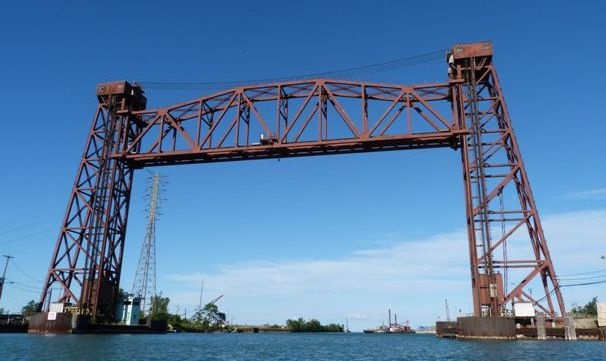
E, J & Easter Railroad Bridge over the Calumet River

Map of the J. Line
In 1988, U.S. Steel and the Blackstone Group formed a holding company Transtar, Inc. to serve as shareholders of the E,J & E Railroad and several other affiliated companies. In March, 2007, Blackstone ended its interest in Transtar. It then became a subsidiary of U.S. Steel.
On 1/31/2009, CN purchased the J line. Its plan was to use the railroad as a by pass of the congested Chicago rail system. Transtar retained the facilities in Gary. These were reorganized to form the Gary Railway serving U.S. Steel.

Freight Yards
 raddoc1947